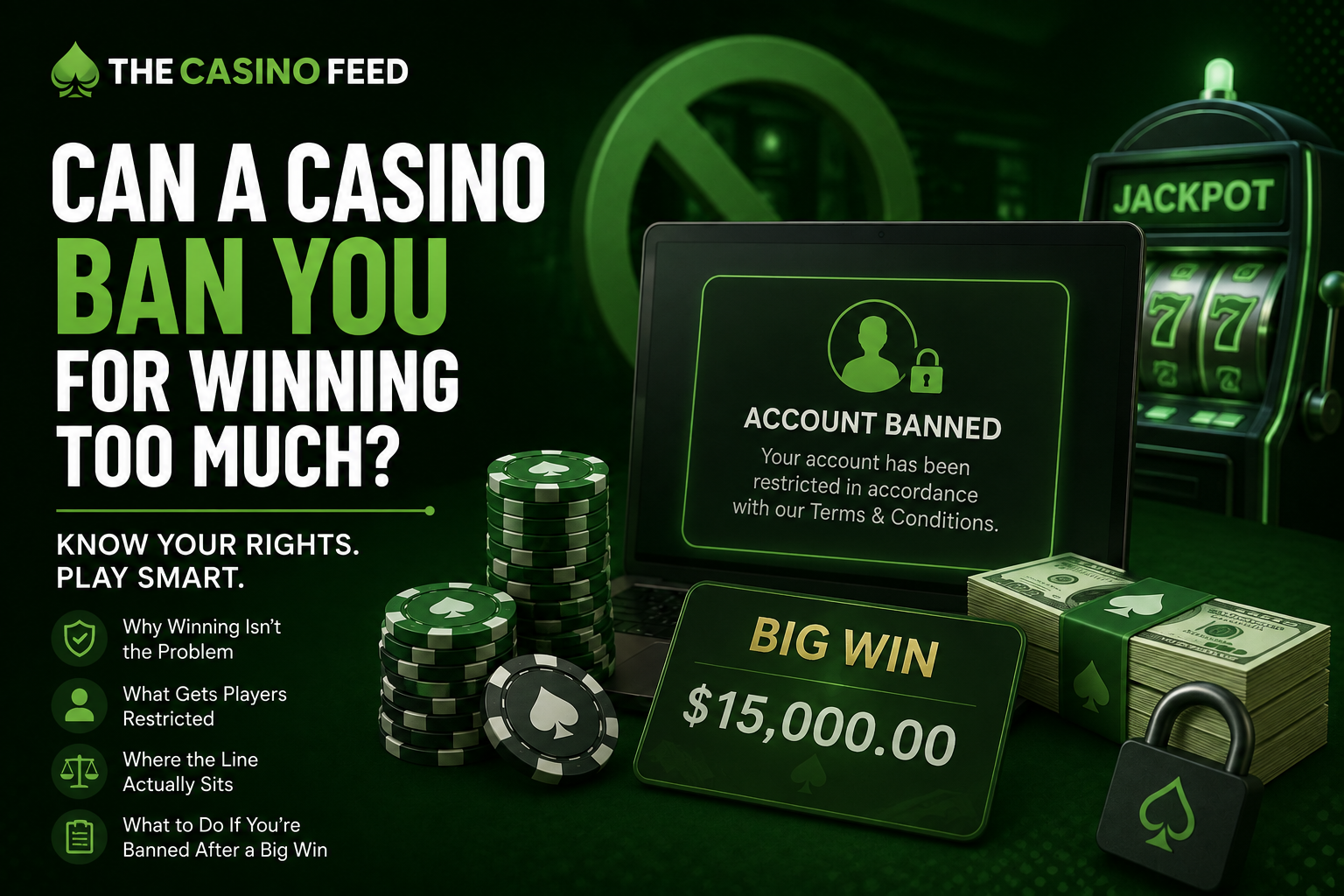
Winning alone is not grounds for a casino ban, and a licensed operator can’t legally void a legitimate win just because it’s large. But casinos do restrict, and sometimes close, accounts tied to specific patterns they consider a threat to their business, advantage play, bonus abuse, or behavior that trips their fraud detection systems. The distinction between “won too much” and “won in a way that broke a specific rule” is where this whole question actually lives.
Why Winning Itself Isn’t the Problem
Here’s the part that surprises people: casinos are built around the math working out in their favor over time, so a single big win, or even a run of them, isn’t inherently a threat. What actually gets a casino’s attention isn’t the size of a win, it’s the pattern behind it. A slot jackpot hit through pure chance doesn’t raise flags the way a consistent, repeatable edge does, because pure luck evens out across enough players, while a genuine repeatable edge doesn’t.
The casinos are also privately owned establishments whose terms and conditions will usually allow them the right to shut down or limit any account without giving the player a full explanation for doing so, similar to what a physical casino can do to someone who enters its premises. It is also important to know that being right and being fair are two different issues.
What Actually Gets Players Restricted
A few specific patterns consistently trigger account restrictions, and none of them are simply “won a lot of money.”
Advantage play. This covers legitimate skill or strategy that shifts the odds meaningfully in a player’s favor, card counting in blackjack being the classic example, or exploiting a specific, favorable rule set in a game. It’s generally not illegal, but casinos are within their rights to consider it undesirable and restrict players who use it, even though no cheating occurred. The most famous case here is Don Johnson, who extracted roughly $15 million from three Atlantic City casinos in 2011 using nothing but perfect basic strategy and unusually favorable terms he’d negotiated directly, no cheating, no card counting. He won fair and square, and the casinos changed their offers rather than voiding his winnings.
Bonus abuse. This is handled completely differently, and in a much more aggressive manner. Creating multiple accounts for the purpose of earning the welcome bonus time and time again, or exploiting free spin and cashback deals in such a way as to go against the conditions of the deal is considered a clear breach of contract at almost all online casinos. The casinos will cross-check IP address, payment method, and behavior on the accounts in order to detect this type of thing, and doing so will result in bans and forfeited bonuses.
Suspicious or high-risk betting patterns. Some platforms restrict players from making abnormally large and risky bets that might cost the site a lot of money if won, regardless of any wrongdoing. This is just a precautionary step by the casino and does not necessarily imply that there is any wrongdoing taking place.
Cheating. Collusion with other players, use of external software or devices, or manipulation of game outcomes are in a different category entirely from the above. These are grounds for both a ban and forfeiture of winnings, and can carry real legal consequences depending on jurisdiction.
Where the Line Actually Sits
The clearest way to think about this: winning through pure chance, or through legal skill within the game’s actual rules, is not grounds for a casino to void your winnings, even if the casino later decides it doesn’t like the outcome. Winning by violating specific terms, using more than one account, using forbidden software, and taking advantage of a known bug is quite another matter, and in this instance, there does seem to be some justification for a casino to react in such a way, assuming they can prove that you violated that particular term.
A casino banning or limiting you without giving you a reason and without citing any particular rule certainly gives cause to complain. In case they can show a particular term you have violated, whether you knew about that term or not, you’ll find yourself in trouble, and that is why it is crucial to study terms and conditions before claiming a bonus.
What to Do If You’re Banned After a Big Win
Contact the casino in writing and ask for the specific reason, referencing the exact term or policy they believe was broken. If the explanation doesn’t hold up, or no clear reason is given at all, the same escalation path applies here as with any withheld payout, formal complaint, then Alternative Dispute Resolution or the relevant licensing regulator if the casino won’t resolve it directly.
Understanding where casinos actually draw this line matters more than most players realize, and it’s exactly the kind of fine print worth checking before you ever place a bet. If you want to know which casinos have clear, fair terms versus which ones bury restrictive clauses that get invoked after the fact, that’s exactly what The Casino Feed checks and rates in every review.
FAQ
Can a casino take my winnings if I win too much?
Not simply for winning a large amount through legitimate play. Casinos can withhold or void winnings when a specific term was broken, bonus abuse, prohibited software, or a documented rule violation, but pure luck or legal skill within the game’s rules isn’t grounds to confiscate a win.
Is card counting illegal?
No, card counting itself isn’t illegal in most jurisdictions, but casinos are private businesses and can refuse service to players they identify as counting, without that refusal being unlawful.
Can online casinos actually detect advantage play?
Yes, to a degree. The algorithms look for unusual statistics regarding win percentage, betting pattern, and account activities. It is, however, more difficult to detect advantage play on games of pure chance, such as slot machines, because there is no strategy to be detected here.
What should I do if I think I was unfairly banned?
Contact the casino in writing and ask for the specific reason and the term you allegedly breached. If the explanation is vague or doesn’t hold up, escalate through a formal complaint and, if necessary, an Alternative Dispute Resolution provider or the relevant licensing regulator.