
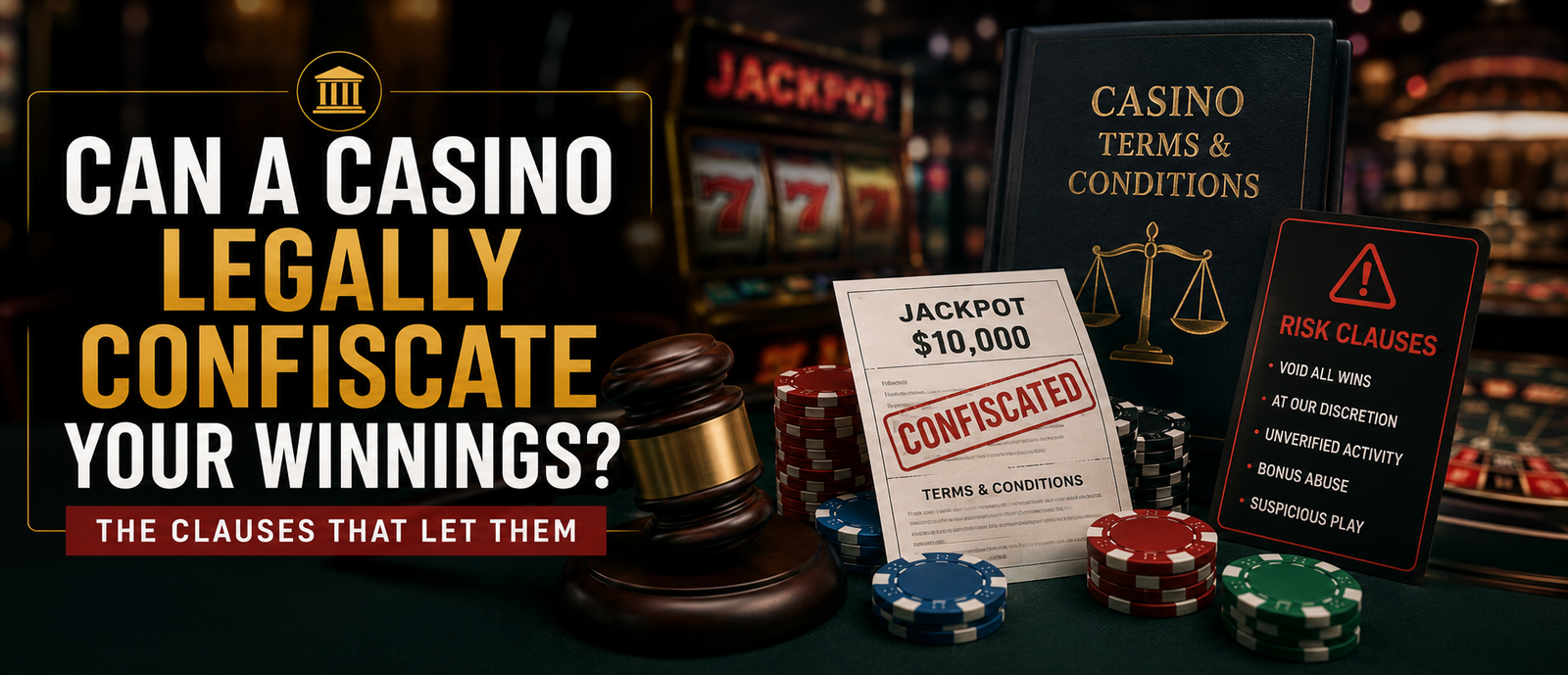
You hit a $4,000 win, you’re already mentally spending it, and then the casino tells you it’s gone. Not delayed. Not under review. Gone, voided under some clause buried in a terms and conditions document you clicked “agree” on eight months ago without reading a word of it.
Can they actually do that? Unfortunately, yes, in a lot of situations, and it’s completely legal. The terms you agreed to almost certainly gave them the right. That doesn’t mean every confiscation is fair, or that you have no options, but it does mean you need to understand exactly which clauses give casinos this power, because that’s the only way to tell a legitimate forfeiture from one that’s being used as an excuse.
Let’s get into the actual mechanics of how and why this happens.
Delay Is Not the Same as Confiscation
Before going further, it’s worth separating two things people constantly lump together: a slow payout and an actually voided balance. These feel identical in the moment, your money isn’t in your account, and you’re frustrated, but they’re completely different situations with completely different remedies.
A delay means the money still exists and is still owed to you; it’s just stuck somewhere in a process. Verification backlog, payment processor timelines, a manual review of a large transaction, these are annoying, but the balance itself hasn’t been taken away. We’ve covered how to tell a real delay from a stall in our piece on what to do when a casino won’t pay you, and that distinction matters here too.
Confiscation is different. That is when the casino clearly says that the winnings are voided, not postponed or anything like that, but voided, usually mentioning a particular clause. Let’s take the case of a player who has won $4,000, waited for five days, and then received an e-mail saying “according to clause 12 of our terms, your winnings have been voided as there was irregular play.” That is not a delay in processing. That is when the balance is actively zeroed out.
The “Sole Discretion” and “Irregular Play” Clauses
It is here that things start to feel truly awkward, as it is rare that the terms and conditions of any casino do not include language granting the casino operator considerable and vague powers. “At our sole discretion” and “in the event of irregular play” are just two examples of the many such phrases that one will find in casinos’ terms and conditions.
“Sole discretion” gives the casino the ability to nullify any wins at their discretion. “Irregular play” is even vaguer. It can mean anything from an actual bot pattern to a betting strategy the casino simply doesn’t like, such as consistently betting the exact same amount on the exact same numbers in roulette in a way that looks “too systematic” to their fraud team.
Picture a player who develops a personal betting rhythm, always betting in small, consistent increments, always on the same handful of games, purely out of habit. If that pattern happens to resemble something the casino’s automated system flags as “advantage play” or “bonus abuse patterns,” a sole discretion clause gives them the legal room to void the win without necessarily proving the player did anything deliberately wrong. It’s not that this always happens maliciously. But the clause exists precisely so casinos don’t have to build an airtight case, the terms simply don’t require one.
What most people miss is that “sole discretion” isn’t boilerplate filler. It’s one of the most consequential phrases in the entire document, because it’s the legal foundation almost every confiscation ultimately stands on.
Bonus Breaches That Trigger a Seizure
This is probably the single most common reason winnings get voided, and it trips up honest players constantly. Bonus terms come loaded with specific restrictions, and breaking any one of them, even accidentally, usually gives the casino explicit grounds to confiscate everything connected to that bonus.
Max bet restrictions are a classic example. Bonus terms frequently cap how much you’re allowed to bet per spin while wagering bonus funds, often something like $5 per spin. Exceed that even once, and many operators reserve the right to void the entire bonus balance and any winnings derived from it, not just the excess amount from that one bet.
Restricted games are another huge trap. Some bonuses explicitly exclude certain slots or table games from counting toward wagering requirements, or worse, playing those excluded games at all while a bonus is active can void everything. A player might not even register that they switched from an eligible slot to a restricted one mid-session, but the system tracking wagering compliance absolutely will.
Then there’s outright wagering violations, withdrawing before the required wagering multiple has been completed, or using multiple browser tabs to play the same bonus simultaneously across sessions. These aren’t obscure edge cases. They’re some of the most frequently triggered confiscation grounds in the entire industry, and they’re almost always spelled out, if you actually read the bonus terms before clicking claim.
Identity and Duplicate-Account Grounds
Confiscation doesn’t only come from in-game behavior. Sometimes it’s tied entirely to who you are, or who the casino thinks you might be connected to.
Failing KYC verification is a big one, if you can’t produce documents proving your identity matches your account, or the documents don’t match the name or age on file, casinos generally reserve the right to void winnings associated with that unverified account. This is standard and defensible; it’s exactly the kind of check we covered in our piece on why casinos ask for ID after you win.
Duplicate accounts are the other major trigger, and we’ve gone deep on this before, shared households, shared IP addresses, even shared devices with a family member can get an account flagged, and confiscation usually follows automatically once a duplicate determination is made, as we explained in our piece on duplicate casino accounts. The terms usually state plainly that only one account per person, household, or device is permitted, and that winnings from any account found in violation are forfeit. Harsh, but it’s written in black and white, and it’s rarely negotiable once triggered.
Legal Enforcement vs a Rogue Grab
So how do you tell the difference between a casino legitimately enforcing its terms and one that’s just using the terms as cover to avoid paying a big win? This is the question that actually matters most in the moment.
Legitimate enforcement usually comes with a specific clause cited, a clear explanation of exactly what rule was broken, and, often, some evidence you can actually check against your own memory of what happened. If a casino says “you exceeded the $5 max bet limit on March 14th during active bonus wagering,” that’s specific and verifiable. You can check your own bet history and confirm or dispute it directly.
A rogue grab tends to look different. The explanation is vague, “irregular play detected” with no further detail, no willingness to specify what exactly was irregular, and no response when you ask direct follow-up questions. If a casino cites a clause but refuses to explain how it applies to your specific situation, or keeps shifting the justification when you push back, that’s the pattern of an operator using terms and conditions as a shield rather than actually enforcing a real rule.
What to Do If Your Winnings Are Held or Voided
If you get hit with a confiscation notice, don’t just accept it and move on. Start by asking support for the exact clause cited and a specific explanation of how it applies to your account, not a generic copy-paste response. Screenshot everything: the confiscation notice, your betting history, any bonus terms you can access.
If the explanation doesn’t hold up, or support won’t engage with specifics, escalate to Alternative Dispute Resolution. Licensed operators under MGA and UKGC are required to provide access to an approved ADR provider specifically for disputes like this, and that process carries real weight because the operator’s license is on the line. Filing directly with the regulator itself is the next step if ADR doesn’t resolve things, and it’s a far more effective route than continuing to argue with a support inbox that has no incentive to change its answer.
How to Avoid It Before You Ever Deposit
The best defense here happens before you ever place a bet. Read the bonus terms fully before claiming anything, specifically the max bet limit, excluded games list, and wagering requirement multiple. Stick to one account per household if anyone you live with plays at the same site.
Complete KYC verification early, right after signing up, rather than waiting until a big win forces the issue. And before depositing anywhere new, actually check the casino’s general terms for how broadly their “sole discretion” language is written, some operators are far more specific and fair about what counts as irregular play than others.
The Bottom Line
Yes, casinos can legally confiscate winnings, and the terms and conditions you agreed to almost certainly give them that power in more situations than you’d expect. The key is knowing which clauses are doing the work, bonus breaches, KYC failures, duplicate accounts, and those broad “sole discretion” catch-alls, and being able to tell a specific, verifiable enforcement action from a vague excuse dressed up in legal language.
Before your next big win turns into a dispute, go read the actual bonus terms and account rules for wherever you’re playing right now. It’s five minutes that could be the difference between celebrating a payout and arguing with a support chatbot.





2 Responses