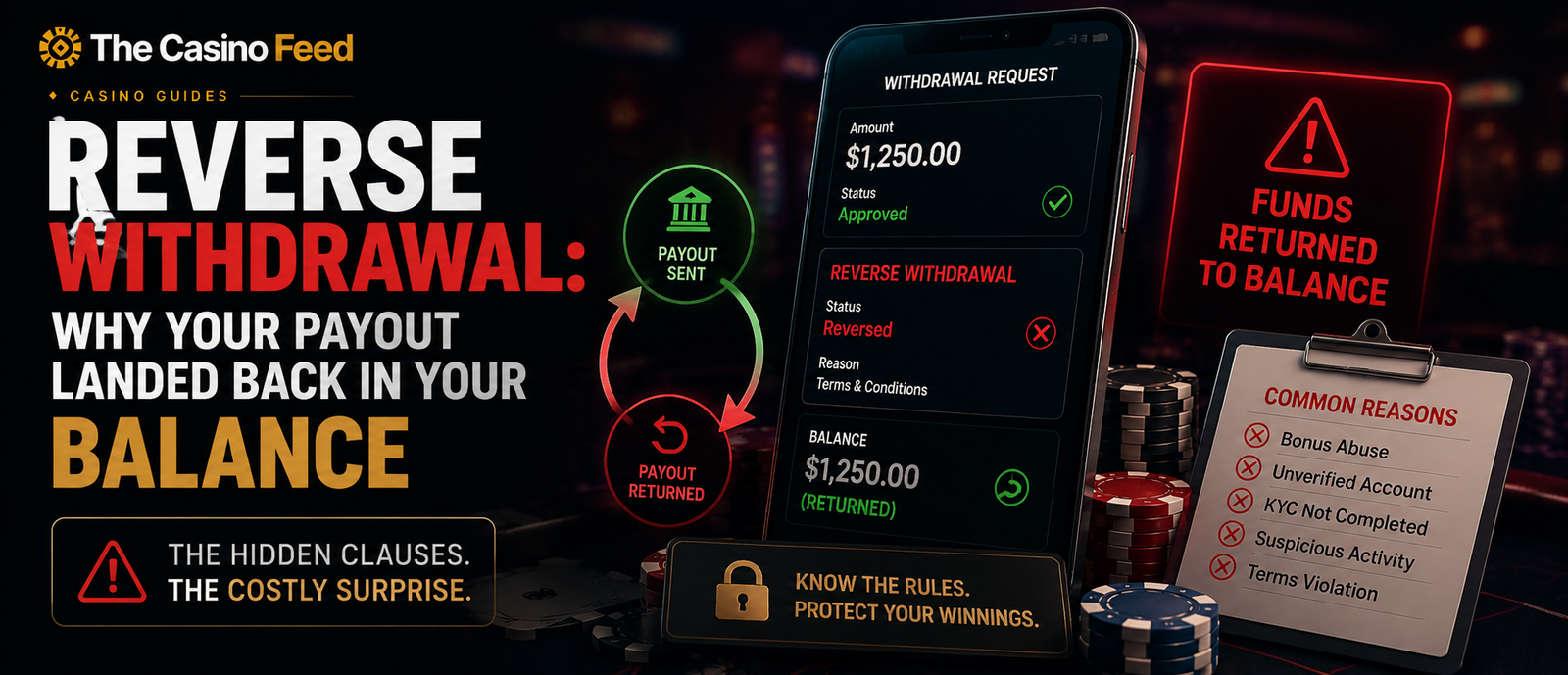
You Cashed Out, So Why Is the Money Back?
You hit a decent win, clicked withdraw, felt that little rush of “okay, this one’s actually leaving the casino,” and closed the tab feeling good about it. Two days later you log back in to check the status, and there it is, sitting right back in your casino balance, not your bank account. No email explaining it. No error message. Just your winnings, quietly reabsorbed into the account like the withdrawal never happened.
Did the casino cancel it? Did something go wrong? Did you get hacked? None of the above, probably. What actually happened is almost certainly something called a reverse withdrawal, and understanding how it works is the difference between losing that money back into the games and actually walking away with it.
What a Reverse Withdrawal Is
Here’s the mechanic, stripped of the mystery. When you request a withdrawal, it doesn’t leave the casino instantly. It sits in a pending state for some period of time, could be a few hours, could be a couple of days, before it actually gets sent off to your bank or e-wallet. During that pending window, some casinos give you the option to cancel the withdrawal and move the funds straight back into your playable balance.
That’s the reverse withdrawal. It’s not a glitch, and it’s not the casino taking anything from you without permission. It’s a built-in feature, usually just a button somewhere in your account labeled something like “cancel withdrawal” or “return to balance.” The catch is that a lot of players never consciously click that button, some interfaces make it disturbingly easy to trigger by accident, and others send a tempting little prompt during the pending window asking if you’d like to “keep playing with these funds instead.”
Picture this: someone withdraws $600, gets an in-app notification a few hours later saying something like “your funds are ready, want to try our new slot release first?” with a big friendly button attached. Click it, thinking it’s just a promo popup, and the withdrawal quietly reverses. The money’s back in play before you’ve even processed what happened.
Why Casinos Build It In
So why does this feature exist at all? On paper, it sounds like a nice convenience, maybe you changed your mind, maybe you want to keep playing with the win instead of waiting days for a bank transfer. And for a small number of players, that’s genuinely how it gets used.
But the real design intent is a lot less charitable than “player convenience.” The pending window creates a moment where your own winnings are dangled in front of you again, right at the exact point where the temptation to keep gambling is strongest. You’ve just won. You’re feeling good. And instead of that feeling ending with money safely leaving the platform, the casino gives you one more easy, low-friction path back into the games, with the withdrawal amount as fresh ammunition.
This isn’t a hypothetical concern. It’s specifically why regulators started paying attention to reverse withdrawals in the first place. The pattern shows up constantly in player casework: someone withdraws, gets tempted or nudged to reverse it, plays the balance back down, and ends up net worse off than if the pending window simply hadn’t existed. The feature quietly feeds losses back into play, using the player’s own decision to cash out as the trigger.
Manual Flushing: How to Lock Your Withdrawal
Here’s the part almost nobody tells you about, and it’s the single most useful piece of practical advice in this whole topic. Many casinos, even ones that technically offer reverse withdrawals, will let you request something called a manual flush if you contact support directly.
A manual flush doesn’t speed up your payout. It doesn’t change when the money actually lands in your bank account. What it does is lock the withdrawal so it can no longer be reversed, removing that tempting “cancel and keep playing” option entirely for that specific transaction. You’re essentially asking the casino to take your own impulse control out of the equation.
The move is simple: the moment you submit a withdrawal, open live chat or send a support email and explicitly ask them to “manually flush” the pending withdrawal so it can’t be reversed. Most operators that offer this won’t advertise it anywhere in their interface, you have to know to ask. A player who’s just cashed out $1,200 and immediately messages support with “please flush this withdrawal so it can’t be cancelled” has, in that one message, closed the exact loophole that costs so many other players their win right back.
Why the UK Banned It
This isn’t a fringe concern dreamed up by cautious players, it’s serious enough that an entire national regulator stepped in and banned the practice outright. The UK Gambling Commission introduced guidance in May 2020 telling operators to prevent reverse withdrawal options, and after a consultation process, that guidance became a permanent requirement under updated technical standards taking effect in October 2021.
The Commission’s own reasoning was blunt about it: reverse withdrawals present a real risk to engaged and vulnerable gamblers specifically because of the temptation to keep gambling with money you’d already decided to walk away from. Under the current rules, UK-licensed operators simply cannot offer customers the option to cancel a withdrawal request once it’s been made, full stop.
What most people miss is that this wasn’t an isolated rule, it came packaged alongside a broader wave of UK player protection measures targeting exactly this kind of psychological nudge, including bans on features that speed up play or disguise losses as wins. Reverse withdrawals were seen as part of the same problem: mechanics that use small design choices to quietly erode a player’s own decision to stop. Other regulators have been watching this space closely, and it wouldn’t be surprising to see similar restrictions spread to additional licensed jurisdictions over time, given how clear the UK’s evidence turned out to be.
Casinos That Remove the Pending Window
If you’re playing somewhere outside the UK’s jurisdiction, this feature might still be very much alive and well on your account, which means the responsibility for avoiding it falls entirely on you, unless you specifically choose operators that don’t build it in.
This is exactly the kind of detail worth checking before you pick where to play seriously. Casinos with genuinely fast payout processing, ones that push funds out quickly rather than leaving them sitting in a multi-day pending state, naturally shrink or eliminate the window where a reverse withdrawal could even happen. If a withdrawal clears in an hour instead of three days, there’s simply less time for a “want to keep playing?” prompt to tempt you back in. Fast-payout operators are worth prioritizing for this reason alone, on top of the obvious benefit of just getting your money faster.
The One Habit That Protects Your Winnings
If you take away exactly one thing from this whole topic, make it this: the moment you click withdraw, treat that money as already gone from the casino, mentally and completely. Don’t check the pending status hoping to “keep an eye on it.” Don’t engage with any prompt, popup, or support message suggesting you play a bit more while you wait. If the option’s available, request a manual flush immediately and remove the temptation altogether.
The Bottom Line
A reverse withdrawal isn’t a mistake or a technical error, it’s a built-in feature that quietly reopens the door you just tried to close, right at the moment you’re most likely to walk back through it. The UK banned it outright because the evidence was too clear to ignore. Until every jurisdiction catches up, the fix is on you: lock your withdrawal the moment you request it, and treat the money as spent the second you hit that button.
Next time you cash out, message support and ask for a manual flush before you do anything else. It takes thirty seconds, and it’s the cheapest insurance you’ll ever buy on your own win.