The Trap in Plain Sight
A player claims a no-deposit bonus, spins it up on a volatile slot, and lands a genuinely huge win, the kind of moment that makes you sit up straight and grin at the screen. The balance reads something enormous compared to the tiny bonus they started with. They go to withdraw it, expecting the number they see.
Instead, the casino pays out a small fraction of it, citing a clause the player never noticed: max cashout. The rest simply evaporates, and it’s completely within the rules, rules the player technically agreed to the moment they clicked “claim bonus.”
This isn’t a rare edge case. It’s one of the most common reasons players feel scammed by a big win that turns out to be nothing like what they expected, and it’s almost always sitting in plain sight in the terms and conditions the whole time.
What Max Cashout Actually Means
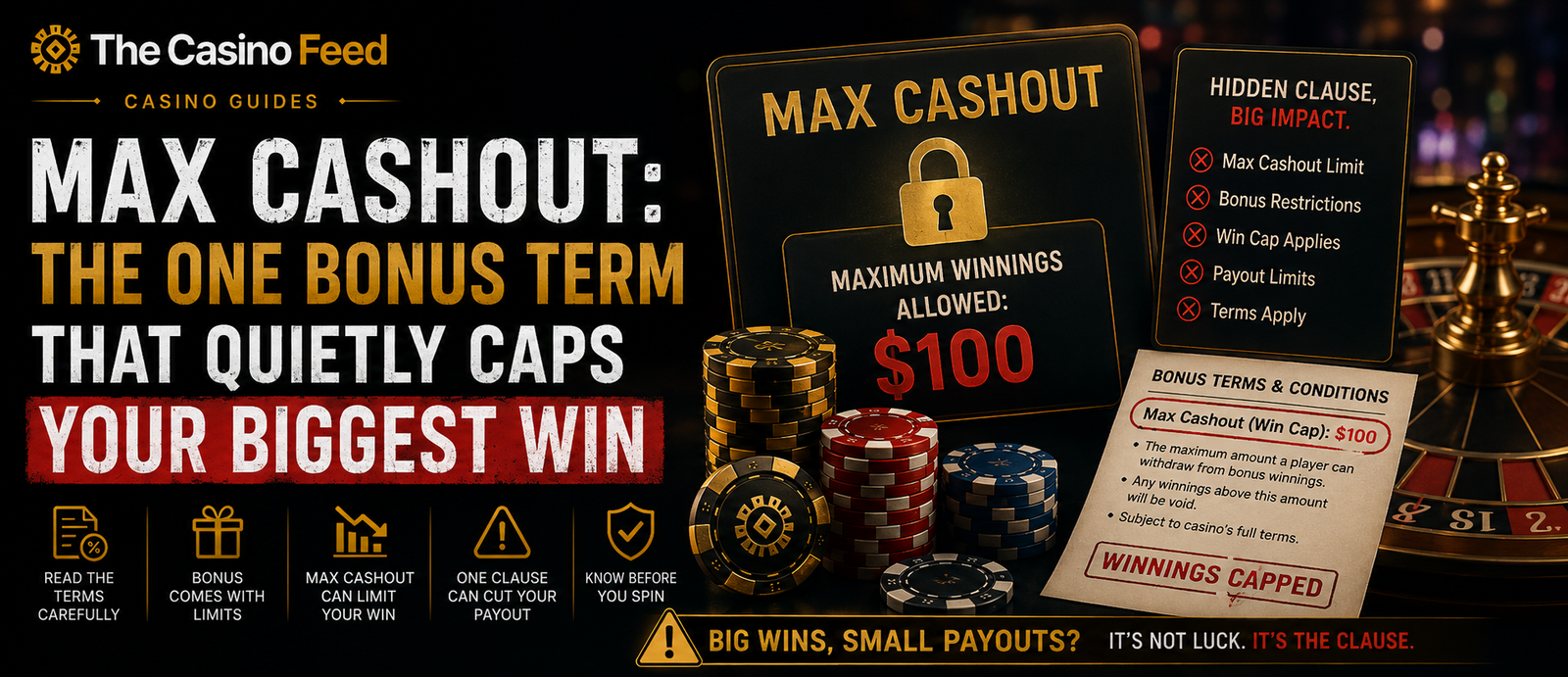
Here’s the plain definition: max cashout is a cap on the total amount you’re allowed to withdraw from winnings generated with bonus funds, regardless of how much you actually won. Win far beyond that cap, and the casino simply doesn’t pay out the difference, it gets removed from your balance before withdrawal, treated as if it never existed.
This is a completely different mechanic from wagering requirements, even though the two get confused constantly. Wagering requirements control how much you need to bet before bonus winnings become withdrawable at all. Max cashout controls the ceiling on what you can withdraw once you’ve cleared that requirement. You can meet every wagering condition perfectly and still lose the bulk of a big win purely because of this separate cap.
It usually hides in the bonus-specific terms rather than the general terms and conditions, often a single line buried well below the headline percentage match or free spin count, worded something like “maximum withdrawal from bonus winnings is capped at [amount].” Casinos aren’t hiding it exactly; it’s technically disclosed. But it’s rarely presented anywhere near as prominently as the exciting part of the offer, and that gap between prominence and importance is exactly what catches players off guard.
Where It Bites Hardest
Max cashout doesn’t apply evenly across every type of promotion. It shows up most aggressively on the offers that look the most generous on the surface, which is exactly the cruel irony of the whole thing.
No-deposit bonuses are the biggest danger zone. Because the casino is handing out free money with zero deposit required, they almost always attach the tightest possible cap, the smaller the initial giveaway, the more likely there’s a strict ceiling on what you can actually extract from it. A generous-sounding “$50 free, no deposit needed” offer might come with a cap that limits your total withdrawal to a small multiple of that starting amount, no matter what the slot itself pays out.
Free spins packages carry similar restrictions, often capping winnings generated specifically from those spins even when the rest of your account plays under normal rules. Welcome offers with big percentage matches, the classic “200% up to $500” style promotion, frequently include a cap as well, though it tends to be more generous than no-deposit offers since you’ve actually put your own money on the line.
The pattern across all of these is consistent: the less skin you had in the game to begin with, the more likely there’s a hard ceiling waiting on the other end of a big win.
A Worked Example of What You Really Keep
Here is an example with clear figures for clarity, making no use of figures from any particular promotion.
A casino gives a player a $20 no deposit bonus with a maximum withdrawal limit of $100. You put the $20 in a highly volatile slot and hit it big so that at one point, you have a balance of $800. Exciting moment, no question.
Now you go to withdraw. Even though your balance shows $800, the max cashout term means you can only actually withdraw $100, the cap stated in the terms. The remaining $700 doesn’t get transferred, disputed, or held for review. It’s simply not withdrawable under the terms you agreed to, and the casino will point directly to the clause if you ask why.
This is the exact mechanic that produces so many confused, angry posts online from players convinced they’ve been scammed. Technically, nothing shady happened. The terms said $100 max, the player agreed to those terms when claiming the bonus, and the casino paid exactly what it was obligated to pay, not a cent more, but also not a cent less than promised.
How It Stacks With Wagering Requirements
Here’s where things get even tighter, because max cashout rarely operates alone. It usually compounds directly with a wagering requirement, and the two together create a much narrower path to actually keeping money than either term would suggest by itself.
Now imagine the same $20 bonus, with the catch of a 40x wagering condition applied to the maximum cash-out of $100. You have to make $800 worth of wagers before being able to withdraw any money at all. Only after clearing that requirement does the max cashout cap even become relevant, limiting whatever’s left to $100 regardless of how much you actually won along the way.
So you’re facing two separate hurdles stacked on top of each other: first, bet enough to satisfy the wagering multiple, and second, accept that even a massive win beyond that point gets trimmed down to the stated cap. What most people miss is that these terms aren’t designed to be evaluated separately, they’re designed to work together, and the combined effect is almost always more restrictive than either term looks on its own when you read them in isolation.
How to Spot It Before You Claim
The fix here isn’t complicated, it just requires actually reading a specific section most players skip entirely. Before claiming any bonus, search the terms and conditions page for the exact phrase “max cashout,” “maximum withdrawal,” or “capped at”, most bonus terms pages let you use Ctrl+F, and this takes about ten seconds.
Look specifically at the bonus-specific terms, not just the general site-wide terms and conditions, max cashout limits are almost always attached to the individual promotion rather than stated as a blanket site policy. Check whether the cap is expressed as a flat dollar amount or as a multiple of the bonus itself, since a “10x your bonus” cap behaves very differently depending on how large your original bonus was.
And pay attention to whether the cap applies only to bonus-derived winnings or to your entire balance including any of your own deposited funds mixed in. Some terms draw that line clearly; others are frustratingly vague about it, which is itself worth treating as a caution sign about how the operator handles disputes generally.
When a Capped Bonus Is Still Worth It
None of this means capped bonuses are automatically bad deals, that would be overcorrecting in the other direction. There’s no denying that a bonus of $100 is still money for free if you fulfill the terms and conditions, despite the fact that it is not a jackpot like the one advertised in the eye-catching advertisements. Just think of it in its actual form as a no-deposit bonus, which is a risk-free way of testing out a casino or any of its games.
Where it stops being worth it is when the wagering requirement is so steep, and the cap so low, that the actual expected value of playing through it barely justifies the time spent. If clearing an 800-dollar wagering requirement for a shot at a 100-dollar cap doesn’t sound appealing once you actually see it spelled out, that’s useful information, and it’s exactly the kind of math worth doing before you claim, not after you’ve already sunk hours into it.
The Bottom Line
Max cashout is the quiet term that turns a jaw-dropping win into a modest payout, and it’s completely legal because it’s sitting right there in the bonus terms the whole time. The trick isn’t avoiding bonuses altogether, it’s knowing exactly what ceiling you’re playing toward before you start, so a big win feels like a bonus instead of a letdown.
Next time a bonus offer catches your eye, search the terms for “max cashout” before you claim anything. If you’d rather skip the search entirely, look for offers we’ve flagged as capped-free or low-cap in our bonus reviews, fairer terms exist, you just have to know where to look.