Why Bad Casinos Do Not Die, They Rebrand
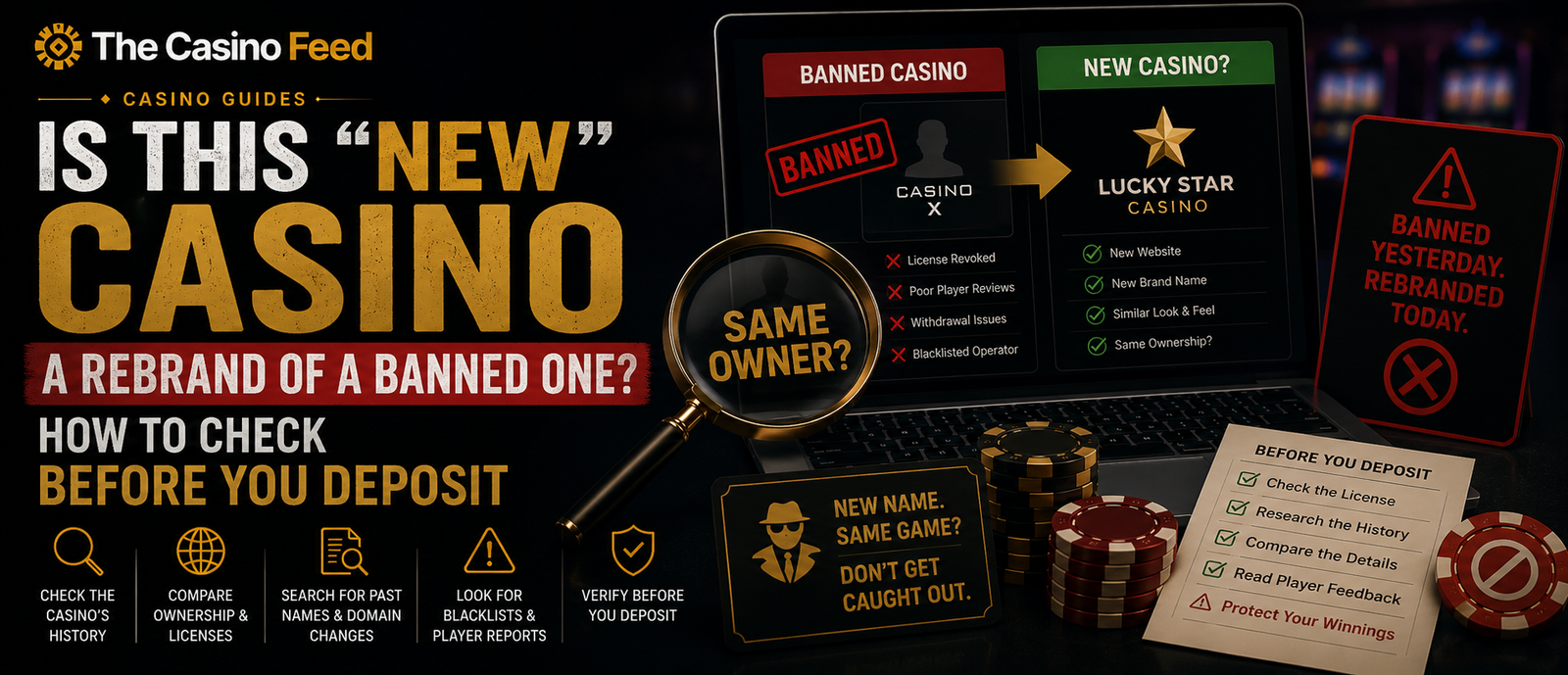
A casino gets blacklisted after months of unpaid withdrawals and a pile of player complaints. Forums light up. Watchdog sites add it to their warning lists. And then, a few months later, a shiny new site appears, with a different name, different color scheme, a fresh welcome bonus, no mention anywhere of the operator’s past.
Except it’s not really new. It’s the same company, the same back-end systems, sometimes even the same support staff typing the same canned responses, just wearing a different logo. This happens constantly in the online casino world, and it’s one of the most effective tricks a bad operator has, because blacklists and bad reviews are tied to a brand name, and brand names are the easiest thing in the world to throw away and replace.
Here’s the thing, you can actually catch this, and it doesn’t require special tools. It just requires knowing where the seams are, because a rebrand can change a logo far more easily than it can change everything underneath it.
Brand, Operator, Group: The Three Layers
Before you can trace a rebrand, you need to understand that a casino site isn’t really one single entity, it’s three layers stacked on top of each other, and only one of those layers is what you actually see.
The brand is the part facing you: the name, the logo, the color scheme, the marketing copy. This is the layer that’s trivial to throw away and replace, and it costs almost nothing to do.
The operator is the actual licensed legal entity running the show, the company that holds the gambling license, sets the terms and conditions, and is legally responsible for paying you. This is buried much deeper, usually in the small print of the terms and conditions or a footer line most players never read.
The group is the parent company or ownership structure that might sit behind multiple operators and multiple brands simultaneously, sometimes running a dozen differently-branded casinos that are all, underneath, the exact same business with the exact same track record.
What most people miss is that a blacklist entry against a brand name does almost nothing if the operator or group just launches a new brand on top of the same underlying license and infrastructure. You have to trace past the logo to actually know who you’re dealing with.
How to Trace the Operating Company
This is the actual mechanical process, and it takes a few minutes once you know where to look. Start in the footer of the casino’s website, legitimate operators are required to disclose the actual company name operating the site, usually in small text near the copyright notice or licensing information, something like “operated by [Company Name] Ltd, licensed under [license number].”
Take that company name and cross-reference it against the license registry directly, the same way we’ve covered in our piece on how to verify a casino license yourself. Search the operator’s legal name, not the casino’s brand name, on the actual regulator’s register, whether that’s MGA, the UKGC, or the Curaçao Gaming Authority. The registry search will often show you the operator’s full authorization history, including previous brand names associated with that same license, if the regulator publishes that level of detail.
Also grab the registration number if it’s listed, since company registries in Malta, Curaçao, or wherever the entity is incorporated can sometimes be searched independently to see the company’s formation date and any prior trading names. A company that was only formed eight months ago, operating a “well-established” casino brand that claims to have been running for years, is an immediate contradiction worth digging into.
Fingerprints a Rebrand Cannot Hide
Even when a company is cagey about disclosing its operator name clearly, a rebrand almost always leaves fingerprints elsewhere, because rebuilding an entire platform from scratch is expensive, most rebrands just reskin the same underlying system.
Terms and conditions are one of the easiest tells. Copy a distinctive, unusual phrase from the new casino’s terms, something oddly specific, not generic boilerplate, and search it. If it matches word-for-word against a blacklisted casino’s old terms page, that’s a strong signal you’re looking at the same operator wearing a new name.
Software and game providers can also give it away, though this one’s weaker on its own since many legitimate casinos share the same third-party game studios. Still, an unusual combination of niche providers matching exactly between an old blacklisted brand and a new one is worth noting alongside other evidence.
Support scripts are surprisingly revealing. If live chat responses use oddly specific phrasing, the same typos, or the same unusual turn of phrase you’ve seen quoted in old complaint threads about a blacklisted casino, that’s a real signal, support scripts get reused far more often than companies think players will notice.
Payment descriptors are important too. When you make a deposit, the name displayed on your bank statement or card statement will correspond to the entity that processes the payments for the casino; this can sometimes reveal the actual casino company even if the website does not provide any affiliation information. Hosting details, however, though more technical, can be investigated with a simple domain search, and sometimes reveal the same server hosting and registration method as another blacklisted domain.
Using Complaints and Blacklists to Check History
After obtaining a license number or candidate operator name, perform a direct search in combination with other keywords such as complaints, scam, unpaid, or blacklist. Communities and forums dedicated to various casinos are quicker at identifying re-branding trends than the official casino itself as they share information with one another in real-time.
Now imagine you happen to see a new casino that claims to be a brand-new player, but when you search the name of its operator (as it is clearly listed in the fine print) you come across a forum post from two years ago detailing another brand that ran an almost identical casino and got shut down after failing to pay their withdrawals. A different logo and the same story, the same operator name. This is exactly what this type of search is used to detect and after you know the real legal name of the operator and not only his/her marketing brand, it takes you minutes.
Green Lights That a New Casino Is Genuinely Safe
But it also doesn’t mean that all new casinos are hidden rebrands, otherwise we would be over on that end and as mentioned in our article comparing new casinos with old, there is plenty of new operators out there that are safe – sometimes safer than old casino brands clinging on to their reputations.
Make sure that the operator name is one that can be verified on the license registry and has no history of enforcement; that the company was registered at a time reasonably close to the time the brand claims it has been in existence; and that the terms and conditions are legitimate and seem as though they have been written from scratch. The transparency of ownership disclosure is a good sign in itself; operators who have nothing to hide are straightforward about who they are, instead of hiding the operator name in the lees complex and hard-to-read footer text.
It has nothing to do with being new and hidden dangers; a new casino with all these green lights. The goal of this process is not to be suspicious of everything, it is to check, rather than assume, in both directions.
Check It in Minutes With the Trust Score
If you’d like to claim a welcome bonus, but you don’t wish to do some digging to trace names and cross-check forum grievances, then that’s what every casino’s Trust Score in our reviews is designed for. We review the operator behind the brand, crosscheck with known rebrand patterns and previous blacklists; before you even have to figure out what all the footer text means.
The Bottom Line
A “new” casino doesn’t necessarily mean it’s a new casino, it can just be a new name from an operator that has lost its reputation under an old name. It’s very easy to throw away the brand, and the terms, the trail of the operator, the support scripts and the payment trail aren’t that easy. Check out the history of the company before you accept any offers.
If you see that the operator’s name is not on the bottom of the site, you will find it in the footer, so pull it out and search for it directly, or simply see its Trust Score and leave the rebrand checking to them.