
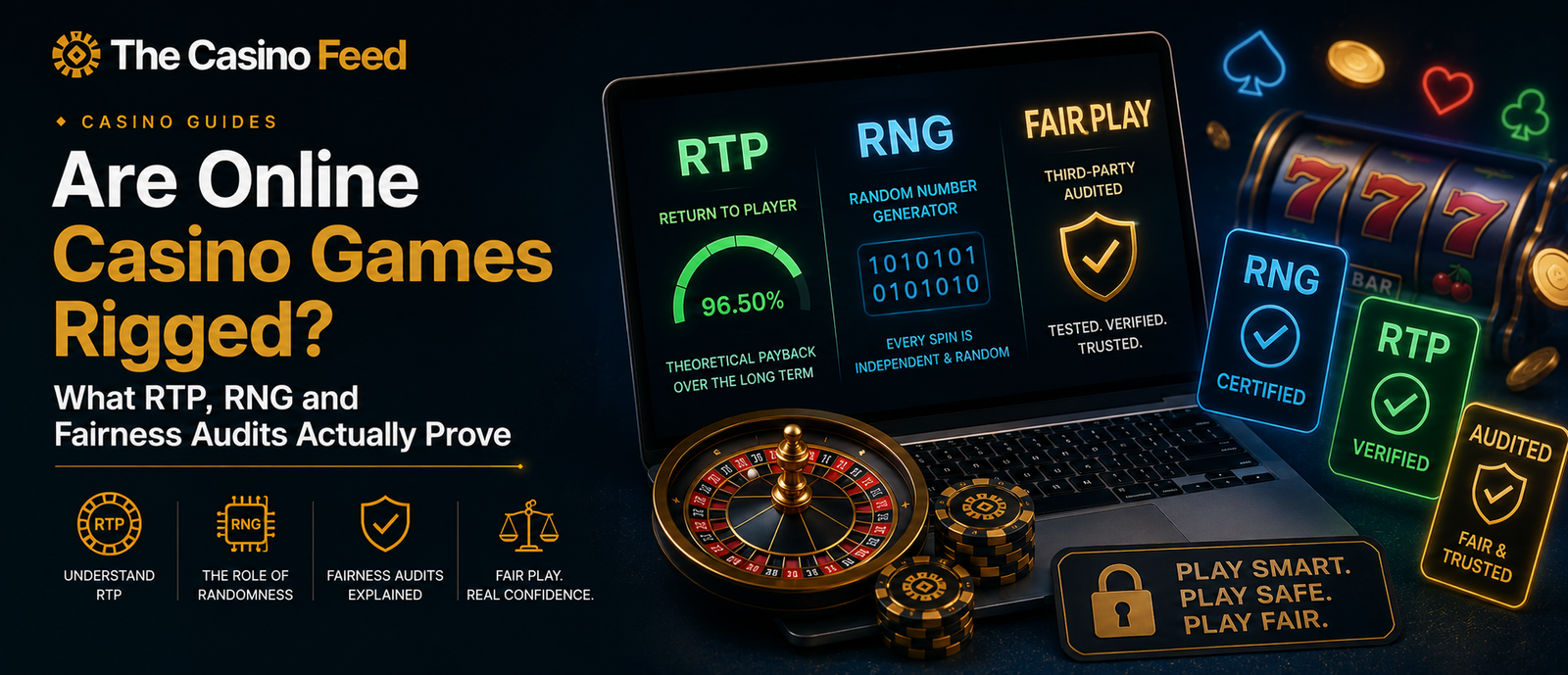
The Fear Behind the Question
Ten losing spins in a row. Then twenty. You’re not playing recklessly, just playing the way you always do, and the losses keep stacking up in a way that starts to feel personal. It’s typically at this time that the question arises: Is this thing really rigged?
It isn’t a paranoid reaction, it’s an honest one. Unfortunately, “bad luck” becomes an unsatisfying explanation when you’re losing streaks from the inside, and when it’s your money that’s at stake. Nobody wants to think they simply got unlucky, it’s more coherent from an emotional perspective when you think the game cheated you.
The fact is that the question deserves an answer and not just some reassurance. Let’s come to understand what RTP and RNG are, what is tested, and where the real risk of getting cheated is.
What RTP Really Measures, and What It Does Not
RTP is a term that means return to player, and it is one of the most perplexing in the entire industry. It is the average percentage that all money played at a game returns to players, but it is important to note that this average is over hundreds of thousands of rounds, not tonight’s session.
Consider how this really translates on the ground. A game that has a high RTP is mathematically engineered to payout more of the money that’s gambled over millions of spins on behalf of all players that have ever played the game. Each of your 200 spins is a tiny morsel of that huge sample, so it is very small and subject to noise. You can definitely lose throughout a session on a perfectly legitimate and proven RTP game and the long run average has nothing to do with what will happen to you during any specific hour.
This is where RTP and “did I get cheated tonight” are two entirely different questions. A casino game that acts the same as it should in its certification can still give you a bad session, which isn’t a contradiction, it’s a statistical average when you’re looking at one number instead of millions.
How an RNG Works in Plain English
RNG stands for random number generator, it’s the true engine that determines what occurs on each spin, hand or roll within a digital casino game. Here’s the “real world” version of math. An RNG is software that will continually produce random numbers, and the number produced when you click on “spin” will determine the number you get for that round.
The key concept is that each round is standalone. The RNG does not recall the previous 10 spins. It’s not responsible to you for your loss and doesn’t “know” you’ve just tossed in a ton of cash. There is no memory of what you have done in the past that can influence what is to come; each individual spin is a new one, and is completely independent of each other.
It is precisely for this reason that betting systems based on the “it’s due for a win” principle do not work mathematically. There is no such thing as what is “due” in the game. If you lose 15 spins in a row, the probability of the next spin will be the same as the first one; just the same; not better, not worse, because there’s no connection between the 15 spins.
Who Actually Tests Games for Fairness
This is where the fear meets an actual answer, because game fairness isn’t just something operators claim about themselves, it’s independently tested by third-party labs with no financial stake in whether a specific game wins or loses.
eCOGRA, founded in 2003 and based in the UK, is one of the most recognized names in this space. It tests RNG integrity and RTP accuracy, but its role extends beyond pure technical auditing, it also assesses operator conduct, including how player funds are handled and whether responsible gambling standards are being followed, and it operates as an approved dispute resolution provider on top of its testing work.
GLI, short for Gaming Laboratories International, functions more like a pure engineering lab, running games through extensive simulated rounds and checking whether actual outcomes align with the theoretical probabilities the developer claims. iTech Labs, based in Australia, sits between the two, combining rigorous technical testing with a broad international footprint across multiple jurisdictions.
However, when it comes to testing, the process is surprisingly down-to-earth: the lab uses the game’s official mathematical model, performs millions of simulations based on it, and sees whether the outcome of these simulations corresponds to what the developer says about his game. If a slot is labeled as having a specific RTP and specific volatility, the lab tests the software to see whether it truly acts this way.
When a Casino Can Genuinely Cheat You
So if fairness testing is this rigorous, can a casino actually cheat you? The honest answer is nuanced, and the nuance matters a lot.
A licensed casino running certified, unmodified software from a reputable game studio is playing it straight, mathematically speaking. The RNG has been tested. The RTP has been verified. The operator generally doesn’t have the ability to reach in and tilt outcomes in real time without breaking the certified software entirely, and doing so would risk their license and certification the moment it was discovered.
The real risk lives somewhere else entirely: unlicensed operators running pirated or cloned versions of popular games, sometimes altered to secretly shift the odds in the house’s favor beyond what the original certified game ever specified. It’s not a hypothetical, it’s a documented issue in the shadier corners of the industry: knock-off casino sites steal the graphics and names of popular slots and then play them on totally uncertified code from the original casino without anyone scrutinising the actual odds and what they’re doing.
Then there is the lesser of evils: you could be on a legitimate site with a game that has, for whatever reason, not been certified by anyone – perhaps it’s a niche game or a newly released one from a smaller less reputable company – and not necessarily been tested the same as some of the big name slots you have. You can’t assume that a casino is certified because it has a license, it is specific to the game and the version of the software.
How to Check You Are Playing the Real Certified Version
Before you assume the worst about a losing streak, do a quick practical check. The casino’s website should display the seals of its testing laboratory, or logos of eCOGRA, GLI, or iTech Labs. Click them. A genuine seal can be followed to a page on the testing lab’s website that displays the actual testing lab certification status, not a picture that leads nowhere or points back to the casino’s marketing page.
Make sure you’re playing a game from a well-known and trusted development studio and not an unknown one with no history. Reputable game providers have each of their titles tested and certification is specific to the version of the game in question and is supposed to be retested if important updates are made to a game, although in some cases that’s not always the case for minor ones.
Some testing labs, in particular eCOGRA, provide operators they certify with real-world RTPs over time, as opposed to one-off lab results, in their payout reports, which are updated monthly. That’s as close as this industry gets to independent checking proof.
The Honest Verdict
Here’s the straight answer: a game running certified RNG software on a licensed platform is not rigged in the sense of tilting the odds against you personally or punishing you for a losing streak. The math is fixed, tested, and independent of your history. Losing sessions happen because that’s how probability actually works over a small sample, not because the software noticed you and decided to take more.
The true danger is that of unlicensed gaming sites with uncertified or even cloned software, where no one knows if the odds advertised are accurate. It’s not the same type of risk and could be analyzed as such instead of all losing sessions.
When the next rough patch comes along and you start to feel like something’s not right, don’t simply dismiss the feeling, click the fairness seal at the bottom of the page and be sure that it does indeed point to a place that’s real. If it has, you may be experiencing a normal variance. If it doesn’t take anywhere that’s when you should start to get concerned.





One Response