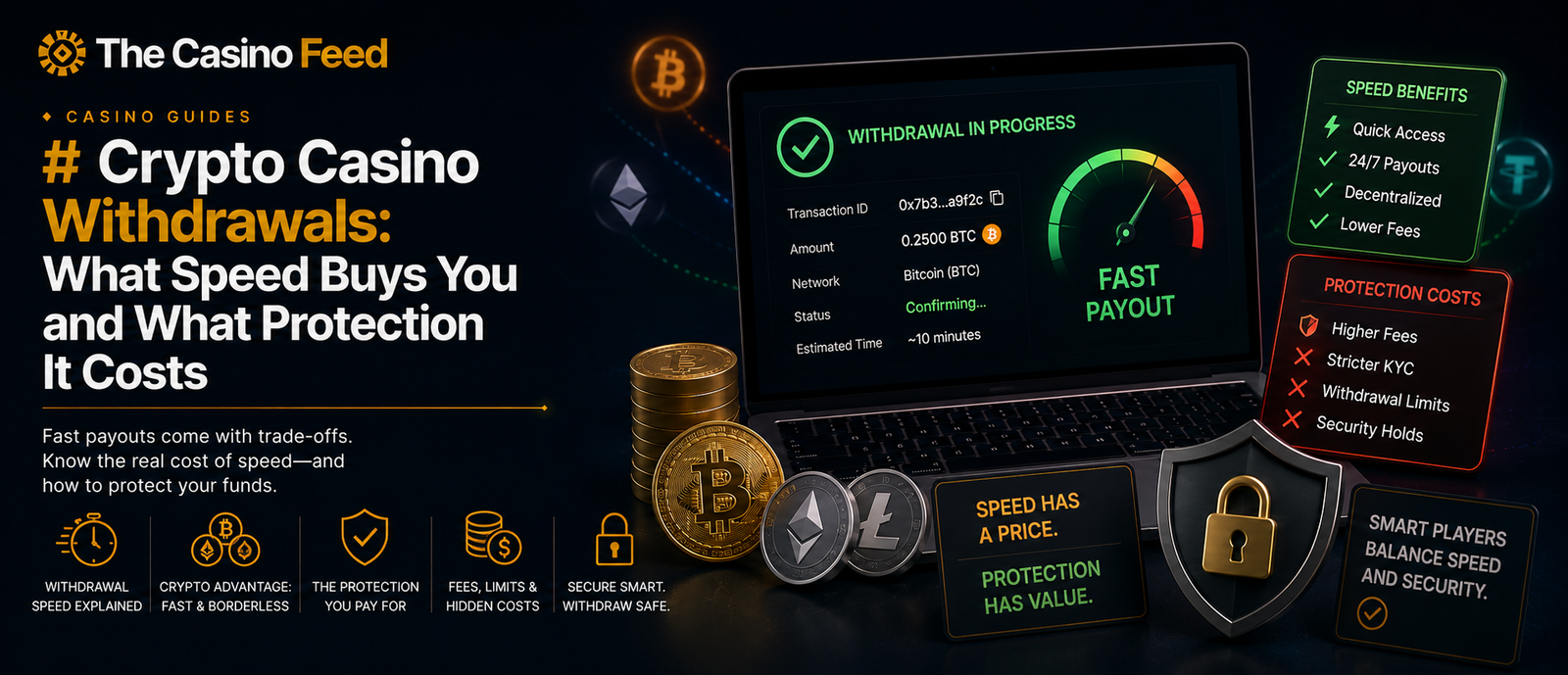
The Trade Nobody Explains
Let’s suppose you win $500 at a crypto casino. Then you hit withdraw and the funds land in your wallet in under ten minutes. Now compare that to a bank transfer that might still be “processing” three business days later. It’s easy to see why crypto payouts have such a devoted following. Fast money feels like good money.
But here’s what almost nobody spells out clearly when they’re hyping up crypto casinos: that speed isn’t free. You’re trading something real for it, the safety net that comes with traditional banking rails, the ability to dispute a transaction, the recourse you have when something goes wrong. Nobody hands you that tradeoff on a napkin before you deposit. So let’s actually lay it out.
Why Crypto Payouts Clear Faster
The speed advantage isn’t marketing fluff, it’s a genuine structural difference in how the money moves. A traditional bank withdrawal has to pass through multiple intermediaries: the casino’s payment processor, the receiving bank, sometimes a correspondent bank in between, each with its own settlement windows and business-hour restrictions. A wire that “should” take a day can stretch to a week purely because of how many hands the transaction passes through before it lands in your account.
Crypto transactions skip almost all of that. When a casino sends crypto to your wallet, it’s a direct blockchain transaction, no bank sitting in the middle deciding when to release it, no business-day cutoffs, no weekend delays. Once the casino initiates the transfer and the network confirms it, the money is simply in your wallet. For popular networks, that confirmation can happen in minutes rather than days.
Picture withdrawing $1,000 in USDT on a Saturday night. A bank transfer request made at that exact moment would just sit queued until Monday morning at the earliest. The crypto version, by contrast, can clear before you’ve finished your next cup of coffee, network congestion depending. That’s a genuinely real, meaningful advantage, it’s just not the whole story.
What You Give Up in Return
Here’s the part that gets glossed over constantly: crypto transactions are irreversible by design. Once a transaction confirms on the blockchain, there’s no bank to call, no chargeback to file, no dispute process that unwinds it. That finality is actually a core feature of how cryptocurrency works, it’s what makes it resistant to fraud in one direction. But it cuts the other way too.
With a card or bank transfer, if a casino makes an error, sends the wrong amount, or a fraudulent transaction slips through, you generally have some avenue for recourse, a chargeback through your card issuer, a bank dispute process, something. With crypto, if a casino sends funds to the wrong address, or a scam operator simply refuses to send your withdrawal at all after taking your deposit, there’s no equivalent safety net built into the payment method itself. The transaction layer doesn’t protect you; only the casino’s own legitimacy does.
Think about what that means practically: if a shady crypto casino accepts your deposit and just never processes your withdrawal, your options are almost entirely limited to complaining to the operator directly or, if they’re actually licensed, escalating to a regulator. There’s no bank standing behind the transaction ready to claw the money back on your behalf. The entire safety net depends on the operator being legitimate in the first place, the payment rail itself offers you nothing.
The Licensing Gap in Many Crypto Casinos
This is where things get genuinely concerning, because crypto and weak licensing have a long, uncomfortable history of showing up together. A meaningful chunk of crypto-only casinos operate under minimal or no real regulatory oversight, sometimes citing crypto’s decentralized nature as a reason they supposedly don’t need traditional licensing at all, which isn’t really how licensing works, but it’s a pitch that’s worked on plenty of players.
Some crypto casinos hold licenses from jurisdictions with genuinely weak enforcement, or operate with no verifiable license whatsoever, leaning on crypto’s pseudo-anonymous nature to make it harder for anyone to trace who’s actually running the operation. Combine an unlicensed operator with an irreversible payment method, and you’ve built the exact conditions that let an operator disappear with player funds and leave almost no practical path to recovery.
This isn’t a reason to avoid crypto casinos categorically, plenty of well-run, properly licensed operators accept crypto as one of several payment options. But it’s a reason to be far more skeptical of crypto-only platforms specifically, ones where cryptocurrency isn’t just an option but the entire business model, often paired with vague or unverifiable licensing claims that wouldn’t survive five minutes of the kind of check we’ve covered in how to verify a casino license yourself.
Volatility Between Winning and Withdrawing
Here’s a wrinkle that has nothing to do with fraud or licensing at all, it’s just math, and it catches players off guard constantly. Cryptocurrency prices move. Sometimes a lot, sometimes within hours. If you win an amount denominated in a volatile coin and there’s any delay between winning and actually cashing out, what you receive in real-world value can shift meaningfully from what you thought you’d won.
Let’s suppose you earn the equivalent of $800 through the use of an altcoin that is highly volatile, but you have to wait for a couple of hours to withdraw your earnings because the transactions take some time. In those couple of hours, the price of the coin drops by 8%, you’re withdrawing whatever the coin is worth at the moment the transaction actually executes, which might be noticeably less. The reverse can happen too, in your favor, but the point is that the number displayed at the moment you won isn’t necessarily the number you’ll actually receive.
Casinos that use stablecoins, cryptocurrencies pegged to a fiat currency like the US dollar, mostly sidestep this problem, since their value doesn’t fluctuate the same way. But plenty of crypto casinos still operate primarily in Bitcoin, Ethereum, or other genuinely volatile assets, and that’s a real cost worth factoring in before you assume your win and your withdrawal are the same number.
How to Use Crypto Casinos Safely
None of this means avoid crypto casinos entirely, it means use them with your eyes open. Check for genuine licensing first, the same way you would with any casino: verify the operator’s license directly on the regulator’s own register rather than trusting a badge in the footer. A crypto casino with a real MGA or Curaçao Gaming Authority license, cross-checked independently, is a fundamentally different risk profile than one with no verifiable license at all.
Use a dedicated wallet for casino play rather than your main long-term holdings wallet, so a mistake or a bad experience doesn’t put your broader crypto assets at risk. Withdraw regularly and in smaller amounts rather than letting a large balance accumulate on the platform, since every dollar sitting in a casino account is a dollar exposed to whatever happens to that operator. If you’re playing with a volatile coin, consider cashing out promptly after a win rather than leaving it sitting, precisely because of the price movement risk covered above. And where the casino offers stablecoins as an option, lean toward those specifically to avoid the volatility question altogether.
When Card or Bank Is Still Smarter
Crypto isn’t automatically the better choice just because it’s faster. If you’re a casual player who values dispute protection more than withdrawal speed, or you’re playing at an operator whose licensing is anything less than crystal clear, a traditional card or bank transfer still gives you a real safety net that crypto simply doesn’t offer by design. The extra day or two of waiting buys you a dispute mechanism that could genuinely save you if something goes wrong.
The honest verdict is that crypto withdrawals are a legitimate, often excellent option specifically when paired with a properly licensed, verifiable operator, the speed is real and the experience can be genuinely better. But the same speed on an unlicensed or vaguely licensed platform is just a faster way to lose money you’ll never see again.
The Bottom Line
Crypto withdrawal speed is real, and it’s genuinely one of the best arguments for playing at a crypto-friendly casino. But that speed comes from removing the exact safety mechanisms, chargebacks, dispute processes, reversal options, that protect you when something goes wrong. The question isn’t whether crypto is good or bad; it’s whether the operator behind it has earned the trust that the payment method itself won’t provide.
Before you deposit crypto anywhere, verify the license independently and stick to stablecoins if volatility isn’t something you want to think about. Or just check our vetted list of licensed, fast-payout crypto casinos and skip the guesswork entirely.