You just requested a cashout. The money’s sitting in a pending state, technically yours, technically on its way to your bank account or e-wallet. Then a button appears: cancel this withdrawal and put the balance back in your account. One click, and instead of waiting two or three days for your money, you’re back at the tables with a bigger stack than you started with. That button is a reverse withdrawal casino feature, and it’s worth understanding exactly what it does before you ever tap it, because it’s built to work against you, not for you.
What Is a Reverse Withdrawal, Exactly?
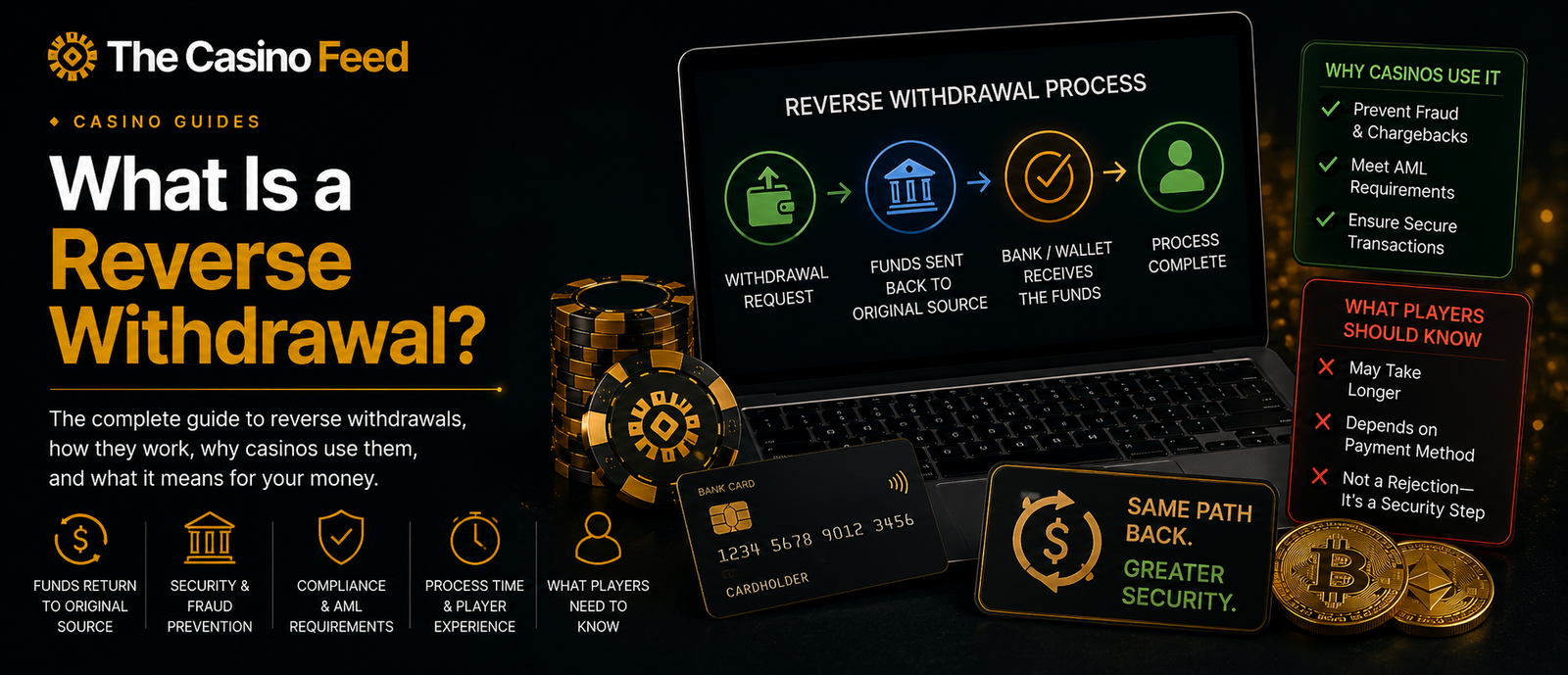
What is reverse withdrawal, in plain terms? It’s a feature that lets a player cancel a cashout while it’s still processing and return those funds to their active balance instead of letting the payment complete. Most online casinos build in some kind of delay before a withdrawal is finalized, often called a pending withdrawal casino period, and during that window, the “cancel withdrawal” or “reverse withdrawal” option sits right there, usually just as easy to click as the withdrawal request itself was.
On paper, this sounds like a convenience. Changed your mind? Found a bonus you want to chase? No problem, just reverse it and keep playing. In practice, it’s one of the more effective mechanisms the industry has built for turning a moment of discipline, successfully deciding to cash out, into a moment of relapse.
Why the Pending Window Exists in the First Place
Casinos frame the pending withdrawal period as a security and processing measure, and to be fair, some of that is genuine. Payment processors need time, fraud and identity checks sometimes run during this window, and reversing a withdrawal that was submitted by mistake is a reasonable thing to allow for.
But the pending window also does something else: it keeps your winnings visibly attached to your account balance instead of removing them from the equation the moment you decide to stop. Psychologically, money that’s “still there” and one click away from being back in play is a completely different proposition than money that’s already left the building. The pending period isn’t neutral. It’s a window of vulnerability, dressed up as standard processing time.
Manual Flushing and How the Reversal Actually Plays Out
Some platforms take this further with what’s sometimes called manual flushing casino functionality, a support-assisted process where a player can request that a pending withdrawal be pulled back manually, sometimes even after the standard cancellation window has technically closed, or through a live chat request rather than a self-service button. Instead of one autonomous decision to reverse, it becomes a conversation, often with a support agent who has every commercial incentive to make that conversation easy and frictionless.
Here’s the pattern this typically follows: a player wins, requests a withdrawal, then, while it’s pending, gets pulled back in by a promotional email, a “your bonus is about to expire” notification, or simply the itch to keep playing. They cancel or manually flush the withdrawal, the balance goes back into play, and in a meaningful share of cases, that money doesn’t leave as a win. It gets wagered back down, sometimes below what was originally deposited. The player who successfully walked away for a moment ends up right back in the session that got them into trouble in the first place.
This is precisely why a reverse withdrawal feature deserves to be treated as a responsible-gambling risk rather than a neutral account setting. It’s not framed to players as “here’s a tool that will very likely cost you money if you use it,” even though that’s closer to the honest description. It’s framed as flexibility. The incentive structure underneath it is not neutral, and it’s worth being clear-eyed about who that feature actually benefits.
Why This Matters More Than It Looks Like It Does
A single reversed withdrawal might seem like a minor decision. But the mechanism scales. For a casino, every reversed cashout is a chance for that money to be wagered again, and the house edge doesn’t go away just because the player already “won” once. For a player, especially anyone who struggles with chasing losses or extending sessions past the point they meant to stop, an always-available reversal button removes exactly the kind of friction that responsible-gambling researchers generally agree is protective. Cooling-off periods, delayed withdrawals, and irreversible cashouts all work in the same direction, they create a gap between impulse and action. A one-click reverse withdrawal collapses that gap back down to nothing.
If you’ve ever reversed a withdrawal and found yourself wagering it back down within the same session, that’s not a personal failing unique to you, it’s the feature working roughly as it’s structured to work. The healthiest approach with any pending withdrawal is treating “cancel” as something you don’t touch once you’ve decided to cash out, full stop, regardless of what pulls at you in the meantime.
It’s also worth knowing what to do if a withdrawal doesn’t go smoothly in the other direction, delayed, disputed, or seemingly stuck instead of paid. That’s a related but separate problem, and it’s covered in detail in My Casino Won’t Pay Me: Is It Fraud or a Real Rule?, which walks through how to tell a genuine processing delay from something worth escalating.
Choosing Casinos With This in Mind
Not every operator handles pending withdrawals and reversal options the same way, and that difference is worth factoring into which casino you actually play at. Some platforms make cancellation prominent and effortless; others build in genuine friction, or don’t offer a reversal option at all once a withdrawal is submitted.
That’s exactly the kind of detail a proper review process should be checking, alongside licensing, payout speed, and complaint history, rather than something that gets glossed over in a generic “best casinos” list. The Casino Feed tests the full cashier experience at every casino it reviews and publishes its full testing process so you can see exactly how a Trust Score gets built before you decide where to play.
If a reverse withdrawal option, or a support agent willing to manually flush a cashout back into your balance, is something you know you’d be tempted to use, that’s worth weighing as heavily as bonus terms or payout speed when picking where to play, because it’s a feature that mostly benefits the house, not the player standing at the cashier.