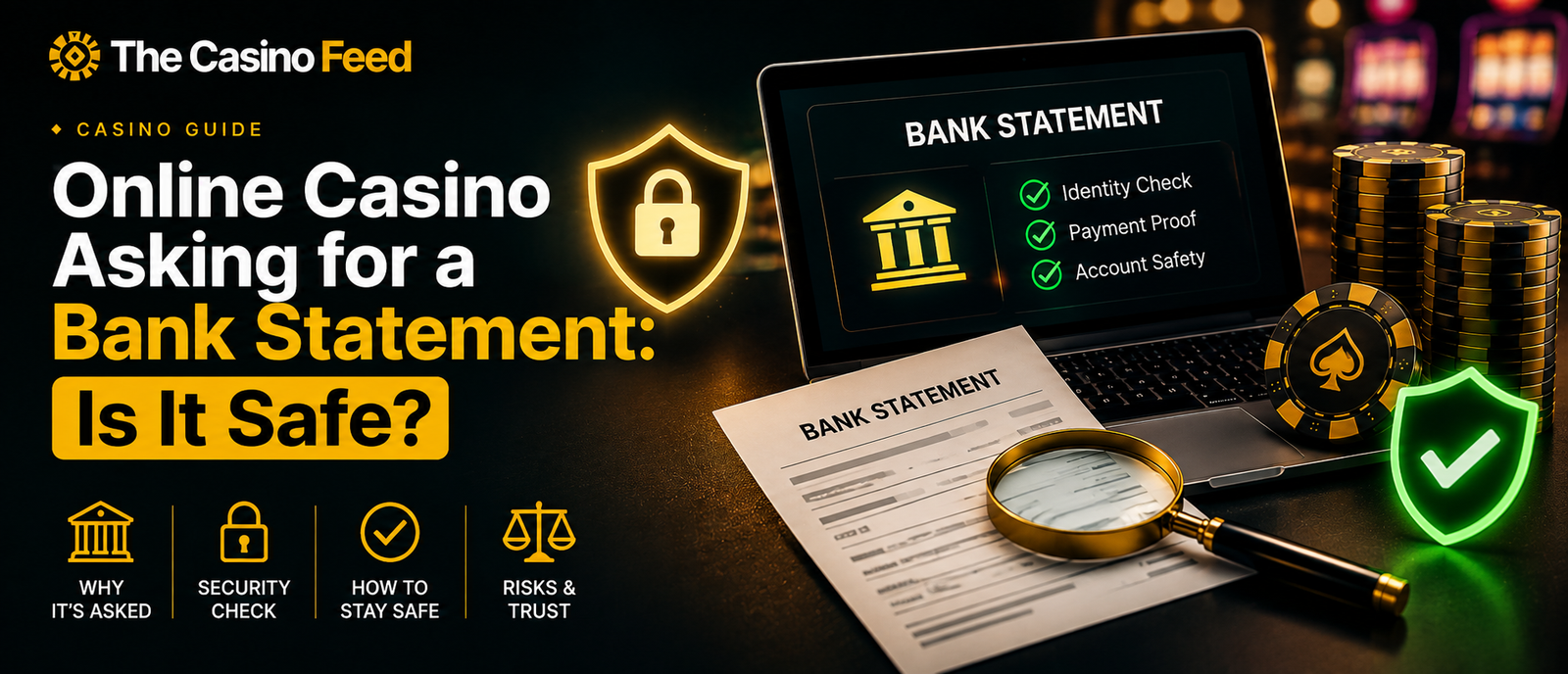
Yes, a licensed casino asking for a bank statement is normal, and it’s usually part of a standard proof-of-address or source-of-funds check. But whether it’s actually safe to send depends entirely on whether the casino is properly licensed and how they’re asking you to send it. A bank statement feels like a bigger ask than a passport photo, and honestly, it is a bit more sensitive, so let’s go through exactly when this is fine and when it isn’t.
Why a Casino Would Want Your Bank Statement
There are two distinct reasons a casino asks for this, and they carry different weight.
Proof of address. A bank statement is one of the standard documents accepted to confirm where you live, alongside things like a utility bill. In this case, the casino mainly cares about your name, your address, and the statement’s date being recent enough, typically within the last three months.
Source of funds, or anti-money-laundering checks. Once your deposits or winnings cross a certain threshold, casinos are often legally required to confirm where that money actually came from, not just where you live. This is a more detailed check tied to your financial activity rather than your address, and it’s the version of this request that tends to feel more invasive, because it’s specifically about your money movements. For the full breakdown of how this works and what to expect, see Casino Source of Funds Request: What It Means and What to Send.
Is It Actually Safe to Send?
This is the real question underneath the search, and the honest answer is: it depends. Not on the document itself, but on who’s asking and how.
It’s safe when: the operator is a properly licensed casino you can independently verify, the request comes through a secure upload portal inside your account rather than an insecure channel, and the request is clearly tied to a specific reason, a withdrawal you requested or a threshold you crossed, rather than appearing out of nowhere.
Treat it as a red flag when: there is no verifiable license, or the license said to be held does not appear on the regulator’s record when you check its validity directly with the regulator. The request is received via email or live chat, rather than in a secure account portal. A bank statement is being requested before you have even deposited, and there is no reason for it to be done for compliance purposes. Or there’s stress and pressure placed, such as “you must send this within the hour” or threats, like your account will be closed immediately if you don’t comply immediately.
Here’s a simple test you can run yourself: search the casino’s name alongside the name of the regulator they use (UKGC, MGA, Curaçao, etc.) and verify the license number directly at the official page of the gaming authority, not on the casino’s home page! Do NOT send anything if the license does not verify independently, no matter how the request is formulated.
What You Can Safely Redact
Most casinos don’t actually need to see your entire financial life. They need specific fields, and blacking out the rest is usually fine and often expected.
Keep visible: your name, your address, the statement date, and, if this is specifically a source-of-funds check, the relevant transaction showing the money in question moving into or out of your account.
Safe to redact in most cases: unrelated transactions that have nothing to do with the funds being checked, your full account number (some casinos are fine with only the last few digits visible), and your overall balance, when the casino hasn’t specifically said they need to see it.
The rules for redactions are truly dependent on the specific operator, so it’s best to check with the casino’s specific request or contact their support team about what actually needs to be redacted before you do so. If you go over the limit of the redacts, it will also generate a resend request.
How to Send It Securely
A few habits keep this process both fast and safe:
- Use the casino’s own upload portal, not email. A secure account-based upload system is standard at legitimate operators. Email attachments are far less secure and easier to intercept or misdirect.
- Send a PDF downloaded directly from your bank where possible, rather than a photo. A bank-issued PDF is cleaner, harder to tamper with, and generally processes faster than a phone photo of a printed or screen-displayed statement.
- Confirm the site is licensed before uploading anything. Do this check first, not after you’ve already sent sensitive financial documents.
- Keep a copy of exactly what you sent, including any redactions you made, in case a dispute comes up later about what was or wasn’t provided.
What Happens After You Send It
Once submitted, expect a review period that’s typically similar to standard identity verification, same-day to a few business days at a properly run, licensed casino, sometimes longer if it’s part of a deeper source-of-funds review. You may get a follow-up request for additional detail or a different document if something wasn’t clear. Your funds remain held, not lost, during this review. A pending status means the casino is checking, not that the money has disappeared. For a fuller breakdown of realistic timelines and what “pending” actually means for your balance, see What Casino Verification Actually Means (and How Long It Takes).
When to Refuse
You’re allowed to say no, and sometimes it’s the correct move. If the site fails the licensing check described above, or the request pattern matches the red flags from section three, unsolicited timing, insecure channels, pressure tactics, declining to send a bank statement is reasonable, not paranoid.
The trickier situation is when the casino genuinely is licensed but the process still feels like it’s dragging or being used to avoid paying you. That’s a different problem from an unsafe request, and it deserves a different response. See My Casino Won’t Pay Me: Is It Fraud or a Real Rule? for how to tell the difference and what to actually do about it.
FAQ
Why does an online casino need my bank statement? Most commonly it’s used either as a proof-of-address document or, for larger deposits and winnings, as part of a source-of-funds check required by anti-money-laundering regulations. Both are standard, legally required checks at licensed operators, not something specific to your account.
Can I black out parts of my bank statement? Generally yes. Most casinos only need your name, address, statement date, and, for source-of-funds checks, the relevant transaction. Unrelated transactions, your full account number, and your balance can typically be redacted, though it’s worth confirming exactly what a specific casino requires first.
Is it safe to send a bank statement to a casino? It’s safe when the operator is verifiably licensed, the request comes through a secure upload portal within your account, and the request is clearly tied to a specific reason like a withdrawal or a deposit threshold. It’s not safe when any of those conditions are missing.
What if I refuse to provide one? At a licensed casino, refusing a legitimate request will typically pause your withdrawal or account access until it’s resolved, since the check is a regulatory requirement, not optional. If the request itself looks unsafe or the site doesn’t check out as licensed, refusing and walking away is the right call regardless of the consequences to that specific withdrawal.
Handing over financial documents online should feel like a deliberate decision, not a reflexive one. If you want to know which casinos handle document requests through proper secure channels versus which ones push for sensitive information the wrong way, that’s exactly the kind of detail The Casino Feed checks and rates in every review.