
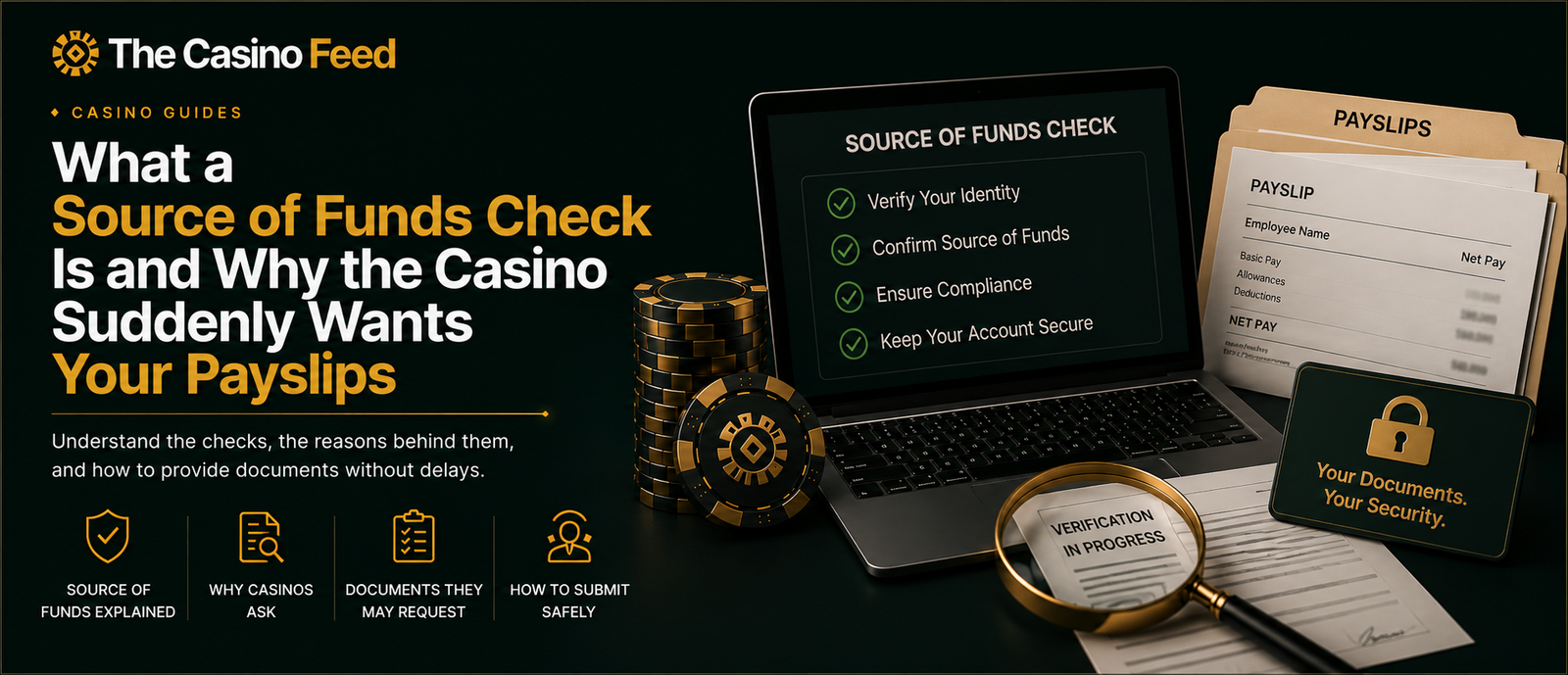
The Request That Feels Like an Accusation
You’re mid-withdrawal, feeling pretty good about a $6,000 win, and then the message pops up: “Please provide your last three payslips and a bank statement showing the deposited funds.” Not a photo ID. Not a utility bill. Your actual payslips.
Isn’t that how it feels like an accusation? Before you know it, you’ve started to wonder whether the casino considers you guilty of something. Do they think you have somehow made your money dirty? Are they simply looking for any excuse to hang on to your earnings?
Well, breathe easy, because, in most cases, that’s not the case at all. This is known as the source of funds check, and it is one of the most misinterpreted aspects of online gambling compliance checks. After learning what it really means and why it’s necessary, that scary-looking requirement becomes nothing more than boring paperwork.
Source of Funds vs Standard KYC
Here’s where a lot of players get confused, because they lump this in with the ID check they already went through. It’s not the same thing, and the difference matters.
Standard KYC, the identity verification we’ve covered before in why casinos ask for ID after you win, answers one question: are you who you say you are? A passport, a proof of address, maybe a selfie. That process confirms identity and age. It doesn’t ask where your money came from. It just confirms you’re a real, legally eligible person attached to the account.
A source of funds check is a completely different animal. It’s not asking who you are. It’s asking where the money you’re playing with, and the money you’re now trying to withdraw, actually originated. Did it come from your salary? Savings? A property sale? An inheritance? This check exists specifically to confirm that the cash moving through the casino isn’t the product of something illegal, and that you can genuinely afford to be gambling the amounts you’re gambling.
Think of KYC as “prove you’re you” and source of funds as “prove this money is legitimately yours to spend.” One’s about identity. The other’s about money trails. Casinos run both, but they trigger at different points and for different reasons.
Why Casinos Are Legally Required to Ask
This isn’t a casino being nosy for the fun of it. Under anti-money laundering regulations that operators like MGA and UKGC licensees are bound by, casinos have to monitor for financial behavior that looks inconsistent with a player’s normal profile, and step in with deeper checks when it does.
There are two separate obligations layered on top of each other here. The first is anti-money laundering: regulators want operators actively watching for large or unusual transactions that might represent funds being “cleaned” through gameplay. The second, especially strong under UK rules, is affordability, operators are required to check that a player isn’t gambling more than they can reasonably afford, based on their actual financial situation. Both obligations point straight at the same tool: ask for evidence of where the money comes from.
Imagine a gambler who has been making small payments for several months and then suddenly makes an unusually large payment of $15,000 within a period of one week and begins betting significantly larger sums than before. This scenario falls right under what the regulatory body expects from the operator.
A source of funds request in that situation isn’t the casino being suspicious of you specifically, it’s the casino doing the exact thing its license requires it to do the moment your activity crosses a certain threshold. Ignore that threshold, and the operator itself risks fines or losing its license. So really, this request exists because the regulator is standing behind the casino, not because the casino woke up distrusting you.
What Documents They Can and Cannot Demand
So what’s actually reasonable here, and where does it cross into overreach?
Reasonable requests typically include recent payslips or an employment letter, bank statements showing the deposits that funded your play, and sometimes documentation for larger one-off sums, like a signed letter for an inheritance, a sale agreement for a property, or a statement showing a bonus payout from an employer. These all directly answer the “where did this money come from” question, and they’re standard across licensed operators.
What tips into overreach is when a casino asks for something with no clear connection to source of funds, full access to your entire investment portfolio history going back a decade, documents about family members who never touched your account, or repeated requests for the same document you already submitted, dressed up as a “new requirement” each time. Reasonable checks target the specific money in question. Unreasonable ones start fishing for everything they can get, or use the request as a moving target that never actually resolves.
One thing worth knowing, you’re allowed to redact sensitive information that isn’t relevant to the check. If your bank statement shows your full transaction history including groceries and rent payments, you can black out unrelated line items and just leave visible the deposits and balance that matter. A legitimate operator only needs enough to confirm the source, not a complete window into your entire financial life.
How to Pass the Check Fast
The fastest way through this is knowing exactly what to send before they ask twice. Payslips should show your name, employer, and net income clearly, blurry phone photos are the number one reason these get rejected and bounced back for resubmission. Bank statements should cover a period that actually includes the deposits in question, not just a random recent snapshot that doesn’t connect the dots.
Match names exactly. If your payslip says “Robert Chen” and your casino account is under “Bobby Chen,” that mismatch alone can trigger a rejection and another round trip of back-and-forth. Fix the account name first if you know it’s inconsistent.
Send everything in one batch instead of trickling documents in one at a time. Compliance teams process submissions faster when they get a complete package, and a partial submission often just sits in a queue waiting for the rest.
And be specific in any note you attach. “This $8,000 deposit came from my annual work bonus, documented in the attached payslip” moves faster through review than silently uploading a stack of PDFs and hoping the reviewer connects the dots themselves.
When the Request Is a Stalling Tactic
Now, here’s the part worth being honest about, not every source of funds request is legitimate, and it’s worth knowing the difference, which we covered in more depth in is it fraud or a real rule.
A real source of funds check has a defined scope, a reasonably consistent timeline, and ends once you provide adequate documentation. A stalling tactic looks different: the requirements keep shifting, the same documents get rejected repeatedly with no specific reason given, or the casino asks for something increasingly unreasonable, like notarized international documents for a modest withdrawal, clearly designed to make compliance nearly impossible rather than to actually verify anything.
If you’ve sent clear, relevant documents and the casino still won’t specify exactly what’s missing or wrong, that’s no longer a compliance process. That’s evasion wearing a compliance costume.
How We Rate Casinos on Verification Friction
This is exactly why verification friction is one of the factors baked into our Trust Score for every casino we review. We look at how often source of funds checks get triggered, how clearly operators communicate what’s needed, and how long the average resolution actually takes based on real player reports, not just what the casino claims in its terms. A casino that runs fair, well-explained checks scores very differently from one that uses “compliance” as a euphemism for indefinite delay.
The Bottom Line
A source of funds check isn’t an accusation, and it isn’t optional for the casino, it’s a legal obligation tied to anti-money laundering and affordability rules that exist to protect the whole system, including you. Send clear, relevant documents, redact what doesn’t matter, and keep an eye out for requests that never seem to end no matter what you provide.
Before you get hit with this mid-withdrawal, check your chosen casino’s Trust Score for its verification friction rating, it’ll tell you exactly what kind of experience to expect before your money’s on the line.





3 Responses