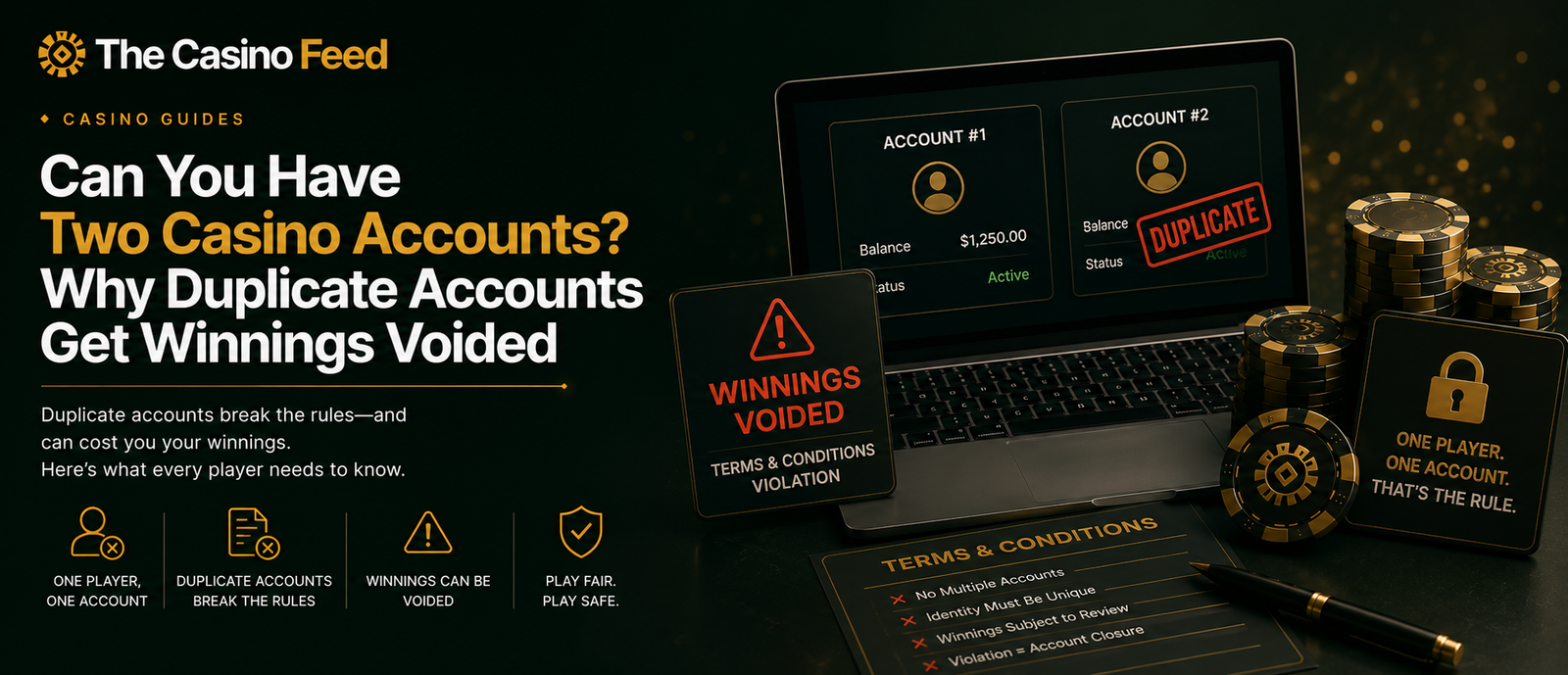
One Household, One Account, One Nasty Surprise
A guy registers at an online casino with his personal card, his personal e-mail, and his personal name. He plays for a few weeks, and then plays a solid $1800 on a slot machine and asks to be withdrawn. He receives an e-mail confirming that his account was deemed as a duplicate and that his winnings have been withheld pursuant to Terms and Conditions, section 14.3.
He is not sure, as he has not had an account there before. It just so happens that his wife had registered at the same casino two years ago, had played a bit and had forgotten about it. Same home WiFi. Same IP address. Same household. As far as the casino’s fraud system was concerned, that was enough to call it a duplicate, and just like that, his winnings were gone.
Feels harsh, right? It is as if you are being punished for something you didn’t realize was a rule. However, that occurs more than many people realize, and knowing the reason why casinos are so stringent about it can save you from losing a win you’re rightfully and squarely due.
What Casinos Actually Count as a Duplicate
Here’s the thing, “duplicate account” doesn’t just mean two accounts under the exact same name and email. Casinos cast a much wider net than most players expect.
The obvious version is when the same person registers for two accounts perhaps with a slightly different email, and takes the welcome bonus twice. There are several of those that are comprehensible to everyone. Casinos also consider accounts to be duplicate accounts if they share the same IP address, device, or even home address, even if they’re not owned by the same user.
Now if you and your roommate both sign up in the same apartment using the same wireless network at the same casino, this is usually enough to cause a duplicate flag even though you are two separate people with two separate bank accounts. The same applies for sharing a laptop with a family member who has an account, even if they are using a different browser or in incognito mode, device fingerprinting can usually identify it.
Most ignore that casinos are not only looking for “is this the same name. They’re looking for a set of signals, IP, device ID, payment method, even browser fingerprint data; if the majority of signals match the ones they already know, they consider it a potential duplicate and ask questions.
Why This Rule Exists
While this might be excessive, there’s a good explanation and it comes from more than the casinos being unnecessarily paranoid.
The primary reason is bonus abuse. Casinos don’t want to provide free spins and welcome bonuses so often that they become a financial burden.Free spins and welcome bonuses are costly to casinos and are only intended to be given one time per player. If there was no duplicate detection, it would be easy for one user to sign up with ten email addresses and then claim their signup bonus, ten times over. Throw thousands of players doing this, and that’s a big cost that undermines the profitability of making bonuses available at all. Duplicate detection is the wall which stops that type of abuse.
The second driver and more serious one is the enforcement of self-exclusion. The players who have signed up to self-exclusion programs are those who have been made aware that they may be addicted to gambling, and are legally prohibited from being able to simply open a new account and begin playing again. There’s a reason why it has to be caught by the operators for regulators to require it. If a person chooses to self-exclude and then attempts to re-join using a different username from the same device, their only stop on the way to re-lapsing is duplicate detection.
But it’s not the idea of suspicion of normal players. It’s a blunt tool designed to grab a smaller number of people wanting to exploit it, or try to thwart some protections they agreed to, and of course it sometimes also catches the innocent.
The Innocent Ways Real People Get Flagged
This is what is really frustrating as there were many players who were flagged for no fault.
Shared housing is likely the most frequent trigger. Anyone sharing an internet connection is sharing an IP address, which is one of the most important indicators that casinos use, and it is important to remember that roommates at college, couples, grown siblings who live together or anyone else sharing an internet connection are sharing an IP address. Two totally different folks, two completely different identities, two entirely different bank cards and two identical signals that run the same wire.
Another big source of false flags are family members. Parents and adult children who live in the same home, but are both interested in the same casino, both sign up for the site independently without knowing the other has already done so, it’s a very innocent situation, and it seems like a case of suspicious activity to a fraud detection algorithm designed to expose scams.
Shared WiFi or public WiFi is a further risk. Imagine someone is playing in a shared network in a coworking environment, a hotel, or a college dorm room. The IP overlap can be enough to raise a flag, if the same network has been used by another player at that casino at some time, even if there is no other link between the two players other than simply being in the same building.
The real answer is that fraud detection systems are designed to catch bad guys and this means that some players are caught in the crossfire. It’s not just, and not necessarily personal or malicious on the part of the casino.
What Happens to Your Deposit and Winnings
This is the part that matters most once you’ve actually been flagged, and it’s worth separating two things that get lumped together in the panic of the moment.
The winnings are usually immediately cancelled in duplicate account detection. This encompasses not only bonus winnings but real-money winnings as well, as the stance most casino will take is that under the rules the account should not have existed and thus all winnings from the account are disregarded.
Your original deposits, though, are typically returned. Most of the licensed operators, particularly those who are regulated by MGA or UKGC, make a distinction between “we are not going to pay out winnings for a rule violation” and “we are not going to keep money that was deposited but never won with playing. If you put $200 in and won $1800, then the $1800 should be gone but the $200 should probably be back, unless the operator is being a dick about it and holding on to the flag to keep the $1800 with him.
If you’re talking about a case, that really counts. Do not struggle for “give me everything back. Realize that the winnings argument and the deposit argument are two distinct arguments, and the second is typically much easier to win than the first.
How to Avoid It and What to Do If Flagged
Prevention here is mostly about awareness rather than some complicated workaround. If you’re sharing a household with someone who plays at the same casino, avoid signing up at that exact same site, pick a different operator instead of risking the overlap. Using mobile data instead of public or shared WiFi when playing for anything but casual, low-stakes reasons is an option if you’re playing seriously. Even if it’s a completely benign variation of your previous account (and it is definitely not a variation that you would purposefully use to “get around” a prior account) duplicate detection is built to look for that.
However, if a player ends up losing after playing correctly, don’t quietly settle for the cancelled winnings. Call the support center and enquire about a specific reason for the flag, IP, device, house, or other reason, otherwise you won’t be able to argue your point if you do not know what you are arguing against. If the explanation is a household or IP overlap, but the person is indeed a separate person, then ask them what would they require to prove that the person is not a member of your household, not using the same payment arrangement, doesn’t have the same government ID, doesn’t have the same address on file.
When they don’t budge and you think the flag is unfair, you must take it up to the license regulator directly, just as we have discussed in our article on how to deal with a casino that doesn’t pay you. Both MGA and UKGC are serious about duplicate accounts if there is clear evidence that the accounts are separate entities, and a complaint is more likely to be taken seriously by a regulator than a conversation with a support chatbot.
The Bottom Line
Duplicate account rules are real for real reasons to prevent players from putting themselves at risk by abusing bonuses and to ensure that the self-exclusion provisions are effective. But the detection systems behind those rules are so bad that they can ensnare innocent users that share a home, network or household. Understand what constitutes a duplicate, maintain consistency and cleanliness in your account information, and, if you’re unfairly flagged for a duplicate, send a rebuttal with specifics rather than taking it.
If you’re already living with someone who’s playing online, it’s best to check today if they’re playing at the same casino as you, or not, before a big win, since it will be much less painful than after a big win.