
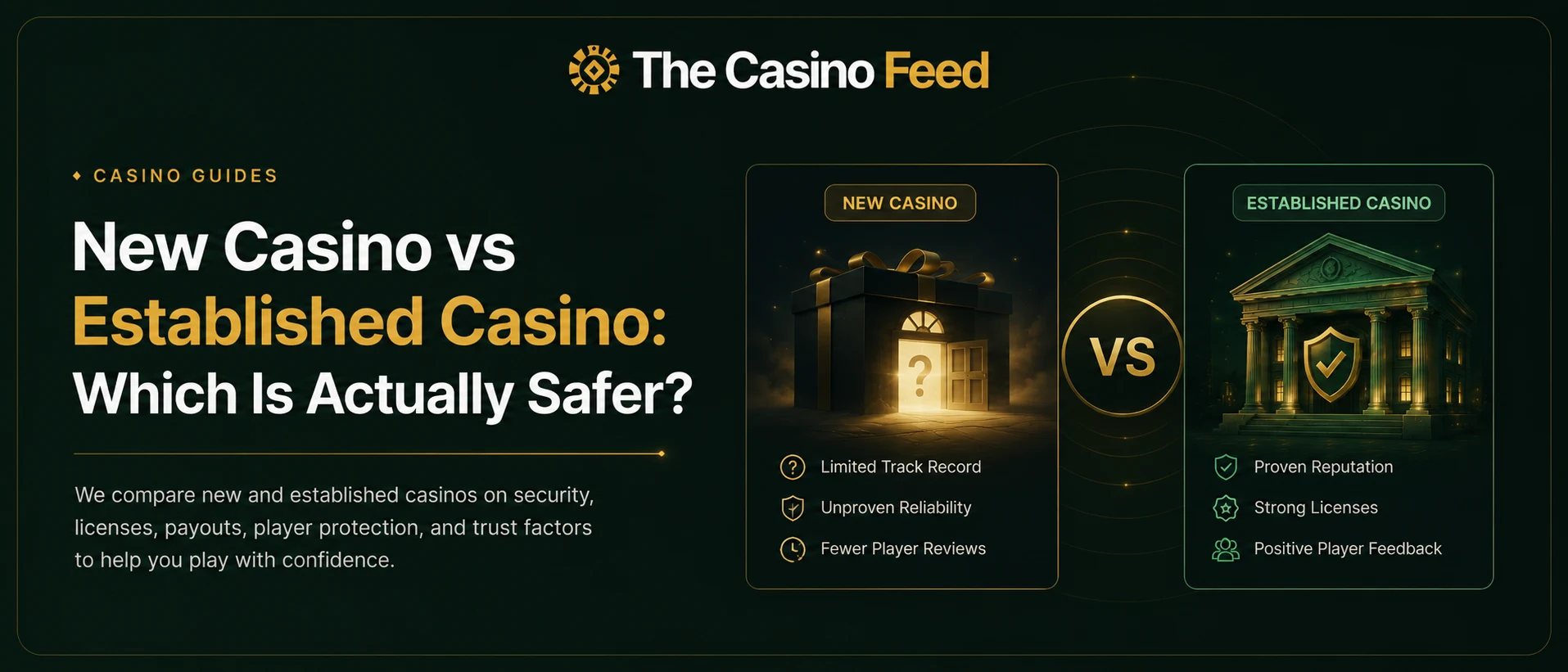
A shiny new casino site lands in your inbox with a 300% welcome bonus and free spins that never seem to run out. Meanwhile, the casino you’ve used for years feels a little boring in comparison, smaller bonuses, the same old games, nothing flashy. So which one actually deserves your money?
It’s tempting to assume newer means riskier and older means safer, like it’s some kind of natural law. But that’s not quite right either. Age alone doesn’t make a casino trustworthy, and being new doesn’t automatically make one dangerous. The real answer is messier and more useful than a simple “always pick the old one” rule.
Let’s actually break this down properly.
Why “New” Doesn’t Automatically Mean Risky
Here’s the thing, every established casino was new once. Someone had to be their first player, taking a chance on a site with zero track record. If everyone avoided new casinos on principle, none of them would ever get the chance to become established.
New operators often have real advantages that older ones lose over time. They’re usually running on modern software, with faster payment processing and cleaner mobile interfaces. They’re hungry for reputation, so they tend to overcorrect on customer service just to build trust quickly. I’ve seen new casinos resolve payout disputes within hours because they desperately needed the good review, something a ten-year-old operator might not bother doing anymore.
Take a hypothetical new site launching under a Malta Gaming Authority license, backed by an established software provider like Evolution or Pragmatic Play. That casino is walking in with serious infrastructure already in place, even if its own brand is a week old. The license is doing a lot of the safety work here, not the age of the company.
So no, “new” isn’t a red flag by itself. What matters is what’s standing behind the new coat of paint.
Why “Established” Doesn’t Automatically Mean Safe Either
This is where a lot of players get comfortable in ways they shouldn’t. An operator sticking around for five or ten years feels like proof of legitimacy. And often it is. But longevity can also just mean a company has gotten good at delaying its own collapse.
Remember when Ladbrokes-style operators or long-running poker rooms would occasionally get caught mismanaging player funds despite years of operation? Age doesn’t prevent bad decisions at the executive level. It just means those decisions take longer to catch up with the company. Some of the messiest casino collapses in the past decade involved operators that had been running for close to a decade before things fell apart, cash flow problems that built up slowly, hidden behind years of seemingly normal operation.
There’s also a subtler issue: older casinos sometimes get lazy. Customer support that used to be sharp becomes outsourced and generic. Terms and conditions quietly shift in the operator’s favor because they know most loyal players won’t read the fine print again. Familiarity breeds a kind of trust that isn’t always earned twice.
What most people miss is that “established” is really just a proxy for something else, evidence of survival. It’s useful information, sure. But survival isn’t the same as good behavior. A casino can survive for years while still cutting corners on the things that actually matter to you.
The Real Factors That Determine Safety, Regardless of Age
If age isn’t the deciding factor, what actually is? A few things matter far more than how long a casino’s domain has existed.
The most important one is licensing. A casino approved by the UK Gambling Commission or Malta Gaming Authority is required to fulfil constant demands, segregated gamers’ funds, regular audits and dispute resolution processes. A ten-year old, low offshore license casino is less “real” of a casino than a six-month old casino that’s licensed by the UKGC, full stop.
There are also the payment processing partners you’re connected with. Any payment provider that is legitimate will carry out their own due diligence before they agree to take part with an operator. The age of the site is a red flag when it doesn’t have a verified processor that supports crypto-only withdrawals.
There’s transparency regarding ownership, too. Just as many new casinos do, established casinos may operate behind a veil of foggy corporate organization. Is it possible to get information on the owner? Is there a real corporate address or is it a PO box in some jurisdiction most people haven’t heard of? That is more than five years of experience operating can tell you.
However, player reviews and complaint ratios are important too, but here’s one caveat: a casino with no complaints could simply be one that has limited review activity. Check how the casino deals with its complaints, not only to see if they exist. Even without years of history to look back on, a new casino that resolves disputes quickly is showing you something of value.
A Practical Comparison, Two Casinos, Same Week
Let’s make this concrete with a scenario. Let’s say there are two casinos, both taking deposits this week.
Casino A is also new, having been launched 18 months ago, has a license from Malta, is powered by live dealer games from Evolution Gaming, has instant payments from Trustly, and the information about the owner is displayed on its “About” page. Payouts are made as soon as 24 hours after reports from early players.
Casino B is a company that’s been operating for a while, and has a history of complaints regarding withdrawal delays that have been extended beyond a fortnight on Trustpilot throughout the last seven years, and yet does not clearly disclose its ownership.
Which one would you give your money to? If it were just about age, Casino B would be your choice. All in all, however, Casino A seems the more secure of the two, albeit the newer. Just when it’s needed most, you use “how long have they been around” as your primary criteria, and you end up at a bad decision.
But that doesn’t mean that every new casino beats every old one; indeed, many of the older, established casino games are quite good, well-regulated, and consistent. The idea is that age isn’t the only piece of information, and it isn’t even the most significant piece.
How to Actually Evaluate Any Casino, New or Old
Just skip the concept of age altogether and go here instead. Look at the license and ensure that it’s from a jurisdiction that has real teeth to enforce it: UK, Malta, and more and more reformed Curaçao licenses. Check out the company ownership; any good operator will have no problem with you doing this. Make sure that they supply a list of the payment processors they use; reputable payment processors will never deal with operators who have shady business practices.
Take note of the recent complaints, rather than the overall star ratings, and watch how complaints are resolved. And try out the waters yourself, place a small amount in initially, try out a withdrawal, see just how smooth it goes prior to committing anything larger.
Do this with any new casino, or a casino that’s fifteen years old. The process remains the same regardless of age, and that’s what is supposed to be the case.
The Bottom Line
The terms ‘new’ and ‘established’ are not guarantees of safety. A newer casino that is well licensed and well run may not be as dangerous as an older casino that’s coasting on its reputation and doing the bare minimum. It’s not the number of candles on the company birthday cake that is the true indicator of safety; it’s licensing, payment infrastructure, ownership transparency, and the way issues are addressed.
If you aren’t sure by feel about age, take 10 minutes to check these points prior to depositing anywhere. A little practice can save you a big headache later.





One Response